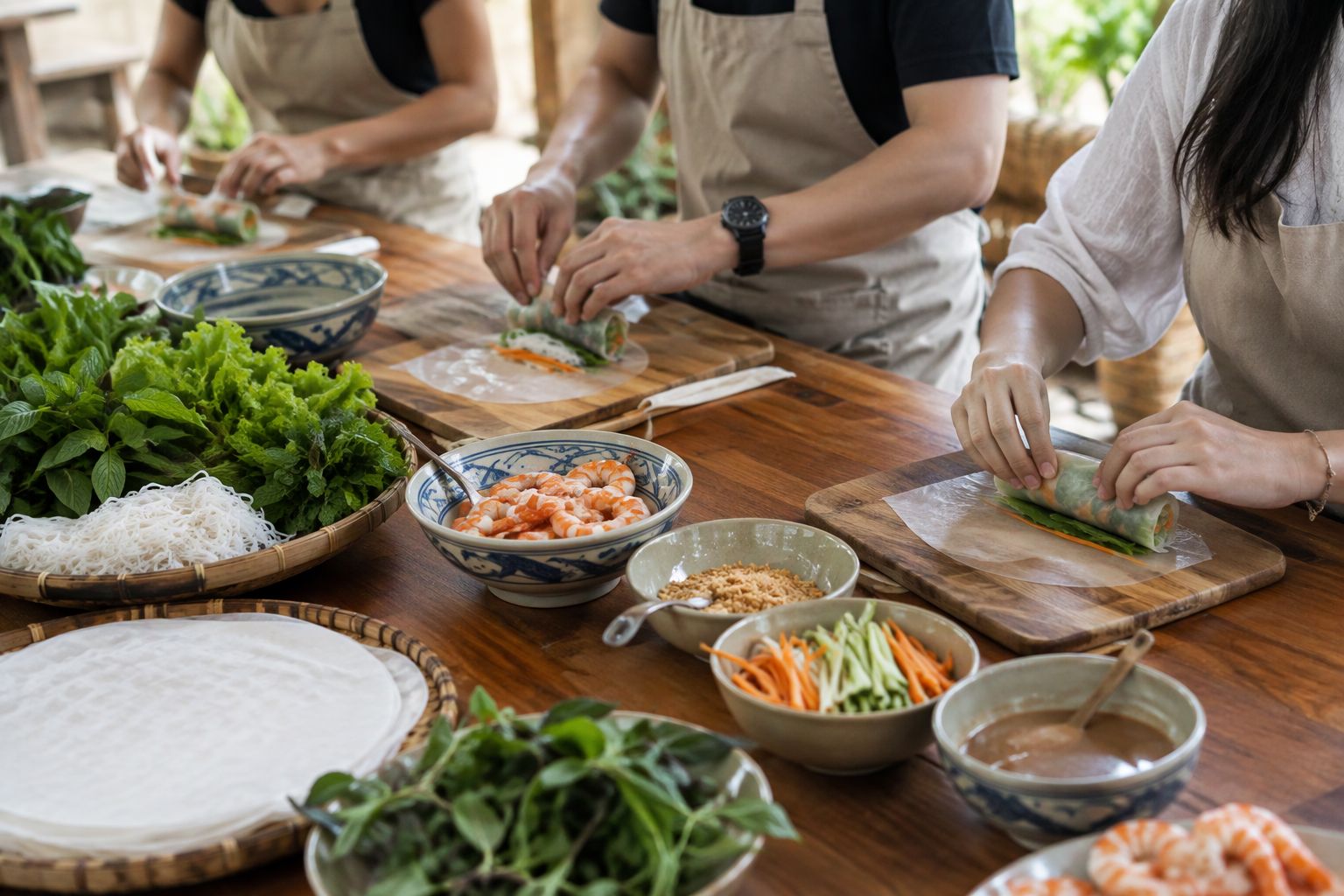
A Vietnam cooking class is one of the most practical ways to learn about the country’s food. You shop at a local market, learn the herbs and sauces, then cook a full meal with a teacher. This guide explains what to expect, where to book, how much to pay, and how to choose a class that suits you.
Many visitors start with street food, but a cooking class adds the missing piece. You learn why a dish tastes the way it does, and you can recreate it at home.
- Choose a market visit: it shows you fresh herbs, fish, and spices before you cook.
- Pick a class that matches your skill: beginners do well with spring rolls and noodle soup.
- Check the group size: small groups give more hands-on time.
- Book in advance: popular classes fill quickly on weekends.
Vietnam cooking class: what a typical lesson includes
Most classes follow a clear pattern. The day often starts with a visit to a local market, where the teacher explains each ingredient. Then you move to a kitchen, where you prepare two or three dishes. Finally, you sit down and eat what you have cooked.
Some schools run a half-day class in the morning. Others offer a full day with a lunch and a second course. Choose the length that fits your schedule, and read the menu before you book.
Popular dishes you can learn
Vietnamese cooking uses fresh herbs, light sauces, and balanced flavours. Beginners often learn these dishes first:
- Fresh spring rolls: rice paper, herbs, prawns, and a peanut or fish sauce dip
- Pho: a clear broth with rice noodles, slow-cooked for hours
- Banh xeo: a crispy savoury pancake filled with pork, prawns, and bean sprouts
- Goi cuon: fresh rolls with a sweet and sour dip
Many schools also teach regional dishes. For example, a Hue class may focus on the spicier cooking of central Vietnam, while a Hoi An class may include cao lau.
How much a cooking class costs
Prices vary by city, class size, and the type of experience. Group classes in Hanoi and Ho Chi Minh City are generally less expensive than private classes. Private lessons offer more attention and flexibility, but they cost more. Prices can also change with the season and the menu.
Ask what is included before you book. A fair price should cover ingredients, the market visit, equipment, and a meal. Ask whether hotel pickup and drinks are part of the fee.
Choosing a good class
Read recent reviews, and look for schools that explain each step clearly. Good teachers explain why ingredients matter, not just how to combine them. Also, check whether the class uses fresh local produce, and whether it caters for vegetarian, vegan, or allergy needs.
Ask about the class size. Groups of six to ten people usually allow everyone to try each task. Very large groups can feel rushed.
Where to take a cooking class
Hanoi is a strong choice for first-time visitors. The city has many schools near the Old Quarter, with market tours that show northern ingredients. Hoi An is known for its relaxed classes and its focus on central Vietnamese dishes. Ho Chi Minh City offers a wider mix of southern flavours, including sweet and sour broths and fresh herbs.
If you travel from one city to another, consider a class in each place. Each region cooks differently, and the comparison is part of the fun.
Tips before you cook
Wear comfortable shoes, because markets involve a lot of walking. Bring a reusable bag for any ingredients you want to buy. Also, eat a light breakfast before the class, because the meal at the end is generous.
Take notes or photos of each recipe. Many schools provide a recipe card, but a short video of your teacher can help you remember the technique at home.
Why a market tour comes first
Most good cooking classes begin at a local market, and this step matters more than many travellers expect. At the market, your teacher shows you the herbs, fish, and vegetables that give Vietnamese food its flavour. You learn to recognise fresh coriander, Vietnamese mint, and rau ram by smell and texture. You also see how families choose ingredients, which helps you shop with confidence after the trip.
Because the market is busy, follow your guide closely. Stalls can be crowded, and motorbikes move through the aisles. Ask questions as you go, and take notes if you want to remember the names. Many teachers enjoy explaining the difference between two similar herbs, and this knowledge helps you cook at home later.
Typical lesson structure
After the market, most classes move to a kitchen. Some are in a restaurant, others in a family home, and a few in a purpose-built studio. Each student usually gets a cutting board, a knife, and a cooking station. The teacher demonstrates each step first, then you repeat it while the teacher watches.
In a typical three-hour class, you prepare three or four dishes. You might start with fresh spring rolls, which need no heat, then move to a broth or a stir-fry. Dessert or a fruit dish sometimes ends the session. Finally, everyone sits down together and eats the meal, which is often the highlight of the day.
Dishes that suit beginners
Some dishes are easier to learn than others. Fresh spring rolls teach knife work and balance, and they need only a few steps. Banh xeo, the crispy savoury pancake, teaches you to manage heat and batter. Pho takes longer, but the steps are clear, and a good teacher will show you how to build the broth. Goi cuon, the fresh rolls with a sweet and sour dip, works well for a light lunch.
If you want a challenge, ask for a regional dish. A Hue class may focus on the spicier central style, with lemongrass and chilli. A Hoi An class may teach cao lau, the noodle dish linked to the old town. A class in Ho Chi Minh City often includes sweet and sour flavours from the south, along with fresh herbs in abundance.
Prices and what they usually cover
Prices vary by city, class size, and the type of experience. Group classes are usually the most affordable option. Private lessons cost more, but they offer flexibility and more hands-on time. Prices change with the season and the menu, so check the current figures before you book.
A fair price should cover the market visit, the ingredients, the equipment, and the meal. Ask whether water, drinks, and hotel pickup are included. Some schools also offer a recipe booklet, which is useful when you cook at home. If the price looks very low, check whether the class includes a real market visit or only a short stop nearby.
Choosing a school and avoiding common problems
Read recent reviews, and look for specific comments about the teacher, the market, and the food. Good schools explain why each ingredient matters, not just how to combine it. Also, ask whether the class can adapt for vegetarian, vegan, or allergy needs. A school that plans ahead will handle these requests with ease.
Group size matters too. Classes with six to ten people usually give everyone time at the cutting board. Very large groups can feel rushed, and you may spend more time watching than cooking. If you travel with a friend or partner, a small class gives you the best balance of attention and company.
Cooking at home after the trip
Back home, start with simple dishes. Fresh spring rolls need rice paper, herbs, cooked prawns or tofu, and a dipping sauce. Buy good fish sauce, and taste it before you use it, because brands differ in strength. Dried rice noodles and rice paper are easy to find in Asian grocery stores, and many keep for months in a cool cupboard.
Plan one new dish each week. Keep your recipe notes in one place, and write down the changes you make. Over time, you will develop your own version of the dishes you learned. Many travellers find that the class becomes a habit, and that the flavours bring back memories of the trip every time they cook.
After the class
Cooking at home can be simple. Start with fresh spring rolls or a noodle soup, and use good stock if you can find it. Buy rice paper, fish sauce, and dried noodles from an Asian grocery. Then try one new dish each week.
A cooking class does more than teach recipes. It gives you a sense of how Vietnamese families shop, prepare, and share food. That understanding stays with you long after the trip.
CTour DMC Vietnam — planning team
We are a licensed Destination Management Company based in Vietnam, designing private journeys across Vietnam, Cambodia and Laos. This guide was written by the planners and local guides who run these trips on the ground, and is reviewed against current conditions before publication. More about our team · Ask us a question
Published 4 November 2026 · 1,446 words · 7 min read