The short answer
- Use private cars for short, awkward distances. They win when the road time is under four hours and a driver saves a whole chain of connections.
- Use the train for the middle distances: Hue to Da Nang, Hanoi to Ninh Binh, Da Nang to Quy Nhon. On those routes it is comfortable, cheap and often faster door to door than flying.
- Use domestic flights for the long hauls only: Hanoi to Saigon, Saigon to Da Nang, Hanoi to Phu Quoc. Budget half a day at each end for airports.
- Count door-to-door time when getting around Vietnam, not journey time. A one-hour flight between two cities with airport buffers usually costs five hours of your holiday.
- Never stack two travel stages on the same day if one of them is a flight, unless you have planned the buffer deliberately.
Vietnam looks compact on a map and then turns out to be 1,650 kilometres from north to south. That single fact decides most arguments about getting around Vietnam. Travellers who plan as though the country is small end up with a two-week itinerary containing five flights. Three of those flights cover distances the train or a car handles better.
Our advice comes from moving people around here every week. Getting around Vietnam works best when transport is part of the holiday. The road from Hue over the Hai Van Pass is an experience, not an overhead. So is the railway north of Nha Trang and the Mekong Delta drive. The flight that skips them is only worth taking when it buys you something better at the other end.
This guide sets out how we choose between private car, train and flight, including the routes where the obvious answer is wrong.
What each option is actually good at
A private car with a driver is a door-to-door service that runs on your schedule. It handles luggage, stops where you want, and works in places the railway does not reach. What it does not do is beat traffic, and Vietnam has traffic in and around every major city.
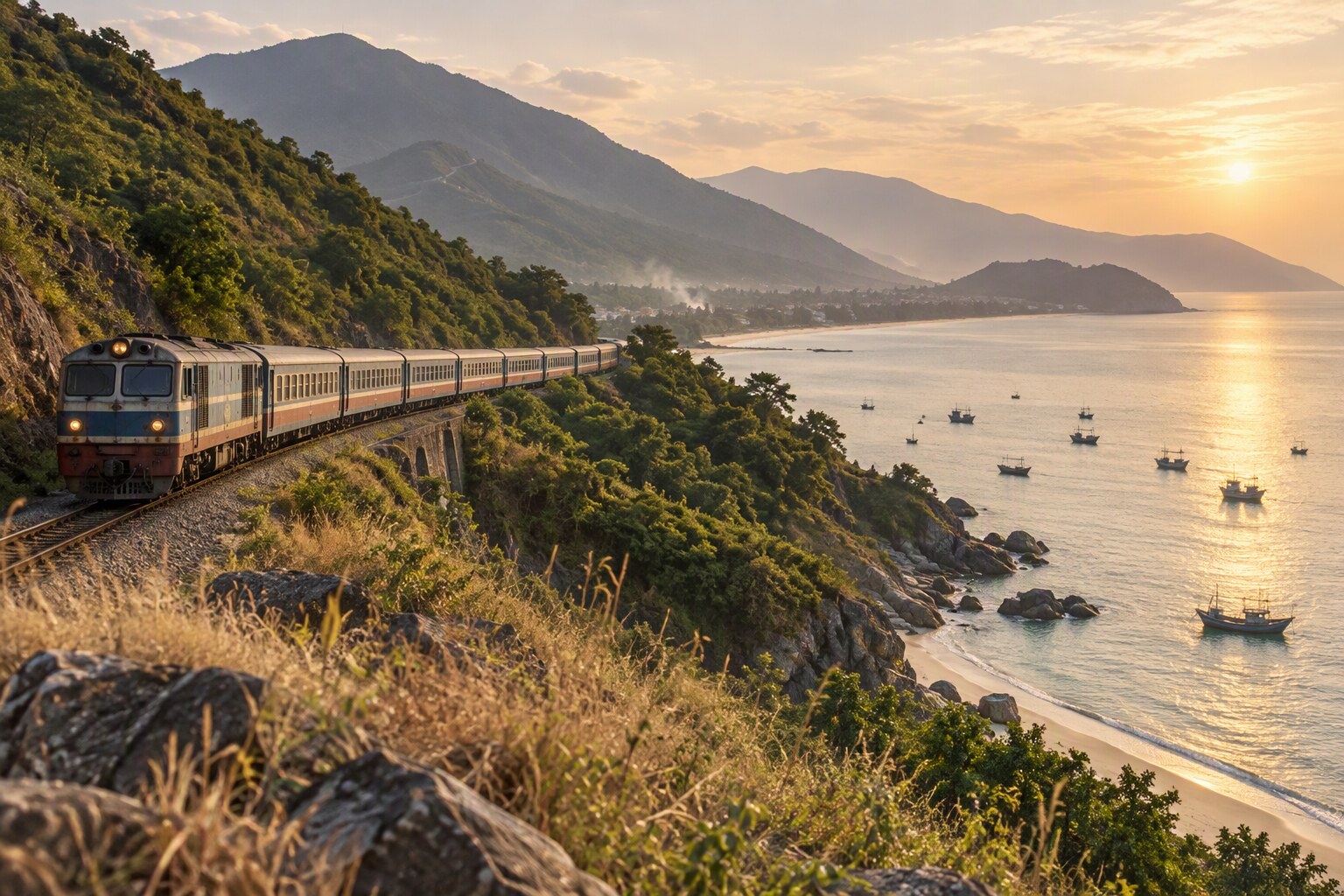
The train is the most comfortable way to cover 300 to 700 kilometres. Seats are spacious by regional standards, you can walk around, and the coastal sections of the north-south line are genuinely beautiful. It runs to a published timetable, which is both its strength and its constraint.
Domestic flights cover the country in an hour or two and connect the far north to the far south. They are also the most fragile part of any itinerary. Schedule changes and weather delays cost you half a day, and the airport buffers add to it.
Getting around Vietnam: where the distances change the answer
There is no single best way of getting around Vietnam, so we think about it in bands rather than in cities. Under 150 kilometres, a car usually wins on total time. Between 150 and 700 kilometres, the train is normally the best combination of comfort, cost and reliability, provided the route is served.
Beyond 700 kilometres, flying starts to make sense. Take it only when the railway does not serve your route efficiently, or you are genuinely short of days. Hanoi to Saigon by rail is a two-night journey. It is a wonderful trip and a terrible use of a ten-day holiday.
Overnight options complicate the bands in a good way. A sleeper train turns travel time into sleeping time, which is the only way to move 700 kilometres without spending a day doing it. More on that below.
When a private car is worth the money
A private car is the most flexible way of getting around Vietnam when the distance is short but the connections are messy. Getting from Hanoi to Ninh Binh is a case where a driver removes two links from the chain. The same is true of Hoi An to Hue over the pass. The run from Da Nang airport to a beach resort south of the city is another.
It also wins when the road itself is the point. The drive through the northern mountains towards Ha Giang is the sort of day that people remember. So is the coast road between Da Nang and Hue, or the run up to Mu Cang Chai. A car lets you stop, which a coach does not.
Group size matters more than distance here. The cost of a car is fixed. A family of four often pays less per person than train tickets plus transfers. So does a group of six. A solo traveller is paying a premium for convenience, and should decide whether that is worth it. Our guide to private versus group travel in Vietnam covers that trade-off in more detail.
When the train beats everything else
Take the train when the route is served and the journey is between three and eight hours. It also helps if your hotel is near a station. It is the most comfortable way of getting around Vietnam over that kind of distance. Hue to Da Nang is the classic example. The three-hour daytime train over the Hai Van Pass is one of the best-value experiences in the country. It beats the drive for anyone who is not stopping along the way.
Hanoi to Ninh Binh, Da Nang to Hue, Nha Trang to Da Nang and Saigon to Phan Thiet all work on the same logic. Soft seats are comfortable, hard seats are cheap and bearable for short hops, and the four-berth sleepers are the sensible choice for overnight runs.
Two things to know before you book. First, the railway does not reach everywhere. Ha Giang, Mai Chau, Sapa town and the Mekong Delta are all reached by road from the nearest station. Second, tickets for the busiest dates and the best sleeper berths sell out, so book ahead in high season. This Vietnam train travel guide covers ticketing, carriage classes and station practicalities in useful detail if you want to arrange a leg yourself.
When flying saves a day, and when it wastes one
Fly when the alternative is an overnight or a full day. Hanoi to Saigon and Hanoi to Phu Quoc are worth a flight on a trip of two weeks or less. So are Saigon to Da Nang and Saigon to Hue. On those routes the plane is not a shortcut, it is the only sensible option.
Be honest about the overhead. Flying is both the fastest way of getting around Vietnam and the easiest way to lose half a day. A one-hour flight costs two airport transfers, a check-in buffer of two hours and a baggage wait. Then there is the recovery period at the other end. Four to five hours of the day disappears. A flight that leaves at 10:00 can consume everything until mid-afternoon once you include the hotel transfer at both ends.
That is why we avoid flights under about 500 kilometres unless the road or rail alternative is genuinely bad. Da Nang to Hue by air is a classic mistake. It is an hour in the air against a three-hour train or drive, plus airports at both ends.
Hanoi to Sapa and Ha Giang: the route with the most opinions
Sapa is reached by road or by overnight train to Lao Cai, then a further drive up into the mountains. The daytime drive takes five to six hours on the expressway and is comfortable. The sleeper train saves a hotel night, but it arrives early and still requires the transfer.
Ha Giang is different. Getting around Vietnam’s northern mountains is a road project. The town is six to seven hours from Hanoi, and the reason to go is the loop beyond it. That loop needs two to three days of driving in the mountains. There is no rail alternative. Anyone considering it should read our northern Vietnam itinerary guide before committing days to the route.
For most travellers, the practical sequence is a private car with a driver who knows the passes. A comfortable overnight train works if the schedule suits. What we would not do is add either destination to a short northern stay and then also add Halong Bay.
The central corridor: Hue, Da Nang and Hoi An
This is the easiest stretch of getting around Vietnam: the densest concentration of simple transport in the country. Hue, Da Nang and Hoi An sit within 130 kilometres of each other, and every option works. Take a private car, the train, or a shared shuttle for the short Hoi An to Da Nang hop.
Our usual arrangement is the daytime train from Hue to Da Nang for the coastal scenery. From there a car or shuttle goes onward to Hoi An. It splits two good experiences across one morning and leaves the afternoon free.
Hoi An itself is reached by road, roughly 45 minutes from Da Nang airport. Plan for that transfer when you book flights. Do not schedule a same-day flight home from Da Nang unless you have a comfortable buffer. Our central Vietnam itinerary sets out how the days fit together. The Hoi An length guide answers the question of how many nights to give it.
The long coastal haul south of Da Nang
South of Da Nang the railway follows the coast through Quy Nhon, Nha Trang and Phan Rang. Mui Ne comes next, then the line turns inland towards Saigon. It is scenic, reliable and slow in the best sense — six to ten hours depending on the leg.
Our preference is to break the journey rather than fly over it. Da Nang to Quy Nhon by daytime train, then a night or two, then onward to Nha Trang. That turns a transport problem into a coastal route. Travellers with ten days or fewer should fly the long sections instead and keep the train for one scenic leg.
If the plan is simply to get from central Vietnam to the south, the flight is the honest answer. Da Nang to Saigon takes about 1 hour 20 minutes in the air and most of a day in practice.
The south: Saigon, the Mekong Delta and short hops
Getting around Vietnam in the south is a road exercise: around Saigon, driving is the only realistic option. The Mekong Delta is a network of roads, ferries and waterways rather than a rail destination. The character of the region comes from the driving between stops. Can Tho is roughly three to four hours from Saigon, depending on traffic leaving the city.
We normally route delta trips as a one-way loop rather than a return day trip. That way the driving is part of the itinerary, not a return journey at the end of a long day. Cu Chi and the delta combine well on the same route, which is why we usually suggest one of them rather than both.
For anything heading to Phu Quoc, the flight from Saigon is short and frequent. The island is not connected to the mainland by road or rail. Factor in the airport transfer and the ferry alternative if flights are disrupted.
Sleeper trains and sleeper buses: what to expect
Sleeper trains are the most underrated part of getting around Vietnam. They come in four-berth and six-berth compartments, with soft and hard classes. The four-berth soft sleeper is the version we book for travellers. It has a door that closes, a reasonable mattress, bedding and enough room to sleep properly. The six-berth option is cheaper and noticeably more social.
Sleeper buses are a different proposition. Some newer operators run comfortable single-berth services, particularly on the northern mountain routes, while older vehicles are cramped and noisy. They are useful for reaching places with no rail service. We would not choose them for a main long-distance leg when a train exists.
Either way, treat an overnight journey as a night of reduced-quality sleep rather than a hotel replacement. Keep the following morning light, and do not book a demanding activity for the same day you arrive.
What the numbers usually look like
The cost of getting around Vietnam varies more by method than by distance. For two people on a 400-kilometre route, a private car typically costs more than two train tickets. It costs less than two flights once airport transfers are included. The gap narrows for groups, because the car price does not change with occupancy.
Train fares rise with class and sell out at the top end. Flights in Vietnam are inexpensive on paper, and the real cost is the day they consume plus the risk of schedule changes. Car hire is priced per day or per route, so a long drive costs more than a short one. It still costs far less than the equivalent days of stop-start transfers.
We quote transport inside the itinerary rather than as a separate line, so the comparison you see is the full door-to-door cost. Our guide to Vietnam trip costs explains what sits inside those figures and what does not.
Luggage, children and travellers who need things to be easy
Domestic flights in Vietnam have real baggage limits, and low-cost fares often exclude checked bags entirely. If you are travelling with large suitcases, the train and a private car are more forgiving, and neither involves repacking at a check-in counter.
Families planning getting around Vietnam should think in terms of transitions rather than distances. Two short drives with a break are easier than one long one. A train with space to move around is easier than a flight for young children. Car seats are not standard in Vietnam and need to be requested in advance.
Travellers with limited mobility should confirm station access, platform distances and boarding arrangements before choosing rail. In many cases a private car removes several physical obstacles that a train or a flight adds, even when it costs more. Our guide to how many days you need is a useful companion here. Generous timing solves more accessibility problems than any single transport choice.
Ask CTour to plan the transport, not only the stops
Send us your dates, your must-sees and your tolerance for early starts. We plan getting around Vietnam as part of the itinerary, not as something to sort out later. We will tell you which legs should be driven, which should be railed and which are worth a flight. If a flight you have already found is a bad idea, we will say so.
Running our own vehicles, with the same drivers and guides year after year, means we can adjust a route mid-trip. Weather and schedules change, and a booking platform cannot do that. That is the part a booking platform cannot do.
Share your party size, luggage, any mobility needs and the cities you want to see. We will come back with a day-by-day plan that includes the transport logic, not just a list of destinations.
Frequently asked questions
Is it better to travel Vietnam by train or by plane?
Getting around Vietnam by train suits journeys between roughly 300 and 700 kilometres, and planes suit the long north-south hauls. The train is cheaper, more comfortable on shorter legs and drops you in the city centre. Flights save time only when the distance is genuinely large.
How long does it take to get from Hanoi to Saigon?
About two hours in the air, plus airport time at both ends, or roughly two nights by train. Most travellers on a two-week trip fly, and those with a month or more sometimes take the railway in stages.
Do I need a private car in Vietnam, or can I use taxis and buses?
In cities, ride-hailing apps work well and are inexpensive. Between cities, a private car with a driver pays off when the distance is short and the connections are complicated. It is also worth it when you want to stop along the way.
Are overnight trains in Vietnam comfortable?
The four-berth soft sleeper is comfortable enough for most travellers, with a door, a mattress and bedding provided. Six-berth compartments are cheaper and busier. Treat the night as reduced sleep rather than a hotel night.
Is it safe to drive yourself in Vietnam?
We do not recommend self-driving for visitors. Traffic rules, road conditions and local driving habits differ significantly from what most travellers expect. A hired car with a professional driver costs little more than the risk.
How early should I arrive at a domestic airport in Vietnam?
Two hours is the sensible buffer when getting around Vietnam by air, at Hanoi, Da Nang and Saigon. Allow more during Tet or public holidays. Traffic to the airport can add 30 to 60 minutes, so build that into the plan.
Can I combine a train journey with a private car on the same route?
Yes, and it often works better than choosing one. It is a common pattern for getting around Vietnam on longer routes. We take the train for the scenic section and a car for the final transfer on several central and northern routes.
What if my flight is delayed or cancelled?
Domestic schedules do change, particularly in the rainy season. We build buffer time into itineraries and keep the following day flexible where possible. That is also why we advise against tight same-day connections.
CTour DMC Vietnam — planning team
We are a licensed Destination Management Company based in Vietnam, designing private journeys across Vietnam, Cambodia and Laos. This guide was written by the planners and local guides who run these trips on the ground, and is reviewed against current conditions before publication. More about our team · Ask us a question
Published 15 October 2026 · 2,859 words · 13 min read