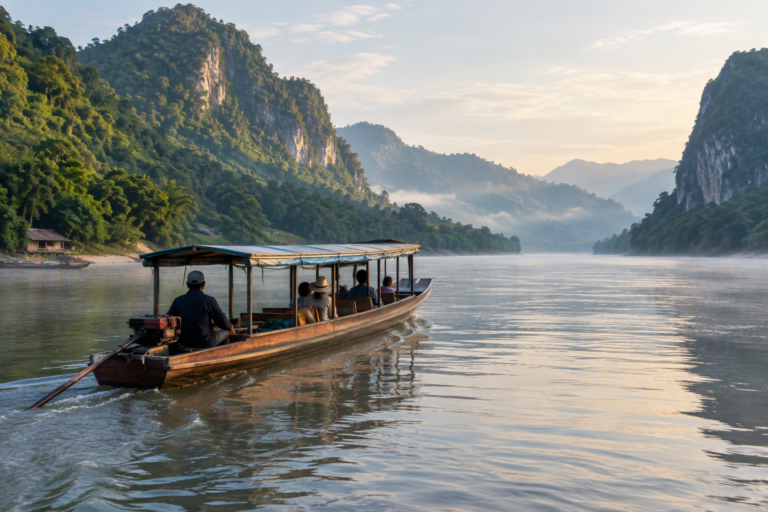
The short answer
- Yes, Vietnam is safe. Violent crime against foreign visitors is rare, and solo travellers, women and older travellers all move around the country without trouble every day.
- The genuine risk is traffic — not crime. Road accidents are the leading cause of serious injury to tourists in Vietnam by a very large margin.
- The common problems are financial, not physical: rigged taxi meters, inflated bills, motorbike-rental damage claims, and being sold a tour that does not exist.
- Bag snatching from moving motorbikes is the one street crime worth actively guarding against, mostly in Ho Chi Minh City and mostly involving phones.
- Do not rent a motorbike unless you already ride one at home and hold the correct licence. This is the single piece of advice that prevents the most ruined trips.
- Travel insurance is not optional. Private hospital care in Hanoi or Saigon is good and is billed up front in cash or card. Our travel insurance guide for Vietnam covers what the policy should include.
We are a Vietnamese tour operator based in Ho Chi Minh City, and this is the question we are asked more than any other — usually by someone whose family has been sending them news articles. So here is the answer we give, without the reassurance and without the scare stories.
Vietnam is a safe country. It is one of the safer places in Asia for a foreign visitor, safer than most large European or North American cities for violent crime, and the overwhelming majority of the roughly seventeen million international visitors who come here every year go home having lost nothing more than a little dignity at a road crossing. Ninety-nine percent of the problems our clients actually report to us are money problems, not danger. What follows is the real list, ranked by how likely it is to happen to you rather than by how dramatic it sounds.
The honest risk ranking
If we had to put the risks in order of how often they genuinely affect travellers in Vietnam, it would look like this:
- Road traffic. Not close to anything else. Crossing streets, riding pillion, and above all renting a motorbike.
- Stomach upsets. Uncomfortable rather than dangerous, and usually from ice, unwashed salad or too much unfamiliar food too fast rather than from street food itself.
- Overcharging and taxi scams. Annoying, avoidable, costs you ten to forty dollars when it happens.
- Bag and phone snatching. Real, localised, and preventable with one habit change.
- Heat and sun. A serious factor from April to August, and the reason more trips get disrupted than any crime.
- Violent crime against tourists. Rare enough that it is genuinely not worth planning around.
Notice what is at the top and what is at the bottom. Nearly everyone worries about the bottom of that list and does nothing about the top.
Traffic: the thing that actually hurts people
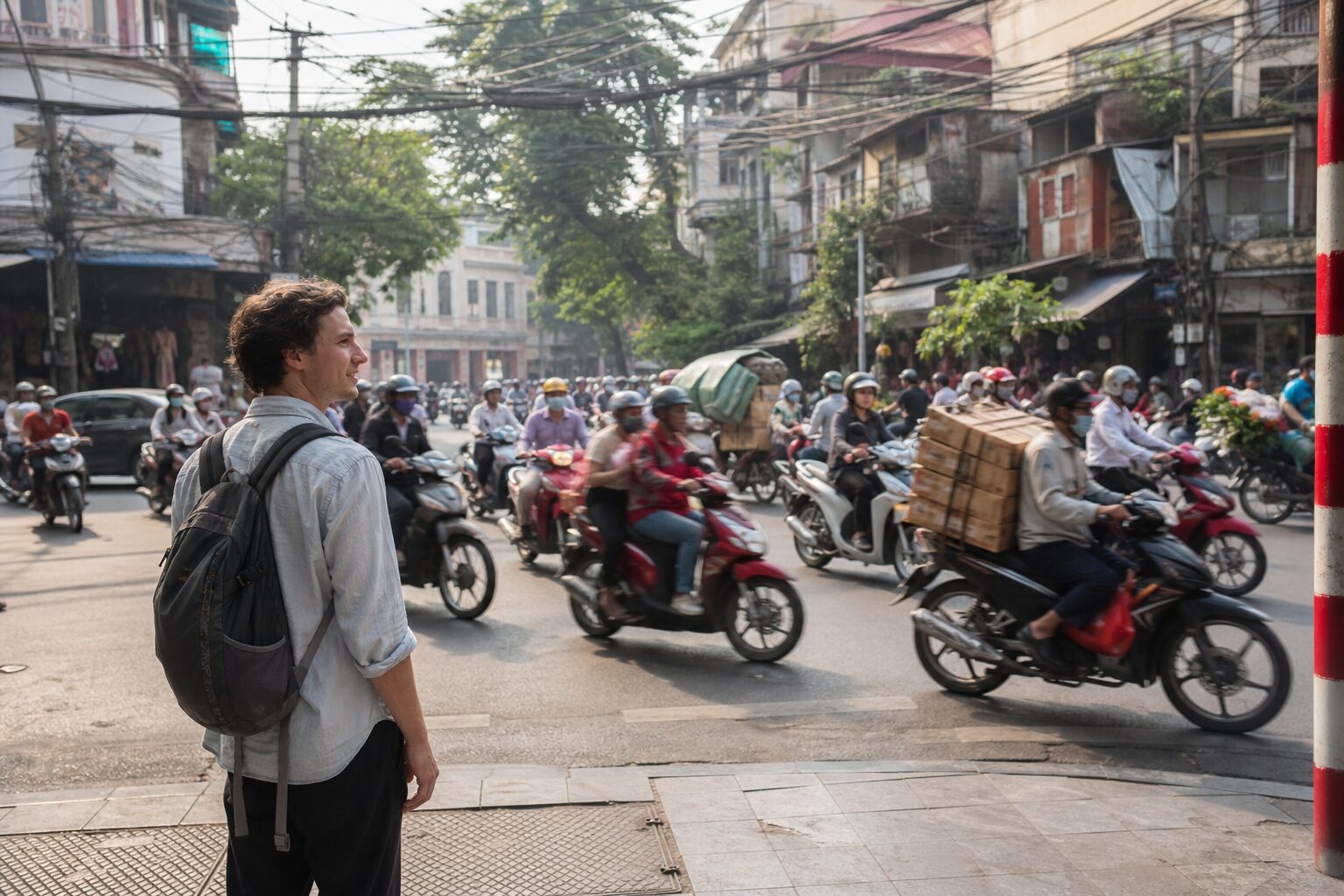
Vietnam has around seventy million registered motorbikes. In the cities they move as a continuous river, they use pavements when it suits them, they turn across traffic, and many junctions function on negotiation rather than rules. It looks like chaos. It is in fact a system, just not the one you learned.
Crossing the road. The technique is counter-intuitive and it works: pick your moment when there are no cars or buses close, then walk out at a slow, absolutely steady pace and do not stop. Motorbikes will flow around you, and they are extremely good at it — they have been doing it their entire lives. What causes accidents is stopping suddenly, jumping back, or sprinting, because the riders have already committed to a line around you. Never run. If you are nervous, stand beside a local and cross when they cross, or walk in the lee of them.
Do not rent a motorbike. We are firm about this. Every year foreign visitors die on Vietnamese roads on rented scooters, and many more go home with road rash, broken collarbones and hospital bills. If you do not hold a motorcycle licence valid in Vietnam — which for most nationalities means an International Driving Permit with the motorcycle category, plus your home motorcycle licence — you are also uninsured, because your travel policy will decline the claim. Read your policy wording on this before you convince yourself otherwise. The romance of the Hai Van Pass on a rented Honda is not worth it; hire a car and driver, or ride pillion with a professional.
Xe om and ride-hailing. Motorbike taxis booked through Grab are fine for short hops and the drivers are competent. Always take the helmet. If you are not comfortable, book a car instead — it is a few dollars more.
Night buses and long-distance road travel. Sleeper buses have a poor safety record on mountain roads and overnight schedules. Where a train exists, take the train instead; it is slower, more comfortable and much safer. There is a good breakdown of Vietnam’s train routes and classes that covers the practical side. Where neither works, that is precisely what a private car and driver is for.
The scams, in the order you will meet them
None of these are dangerous. All of them are irritating, and every one is avoidable if you know the shape of it in advance.
Airport taxis and the rigged meter
The classic. A driver approaches you inside the terminal, quotes a fare that sounds reasonable, then either runs a meter that climbs suspiciously fast or produces a much larger number at the other end, sometimes by claiming the quote was per person or in a different currency unit. A variation: the driver says your hotel is closed or full and takes you to a “better” one that pays him commission.
The fix: never accept a driver who approaches you. Book a Grab or Xanh SM from the app at the official pickup point, join the marked taxi queue and use only Mai Linh or Vinasun, or — simplest — have your hotel or your operator send a car. Airport pickup is included in every trip we run, and it is the single transfer most worth pre-booking on any Vietnam trip.
The note switch
Vietnamese banknotes are colour-coded and two pairs look alike to a newcomer: the 20,000 and the 500,000, both blue-ish, and the 10,000 and 200,000. The scam is to give you change in 20,000s while you believe you are holding 500,000s, or to claim you paid with a 20,000 when you handed over a 500,000. It happens at markets, small shops and in taxis.
The fix: learn the two blue notes on day one — count the zeros, not the colour. Say the amount out loud as you hand money over. Keep large notes in a separate pocket from small ones. Use card where you can, and pay with exact change at markets.
Shoeshine, cyclo rides and the “friendly local”
Someone points at your shoes, takes them before you agree, does a quick job and demands a large sum. Or a cyclo driver agrees a price for a tour and then asks for many times that at the end, sometimes aggressively. Or a very friendly English-speaking student wants to practise conversation and ends up steering you into a shop or a bar with a startling bill.
The fix: a firm “no thank you” and keep walking. Do not let anyone touch your shoes or your possessions. If you do want a cyclo ride, agree the price in writing on a phone screen, in dong, for the whole trip and for all passengers, before you sit down.
Motorbike rental damage claims
You rent a scooter, they keep your passport, and on return they point out a scratch that was there before and demand a few hundred dollars. Because your passport is behind the counter, you pay.
The fix: do not rent one. If you insist, never hand over your passport — leave a photocopy or a cash deposit, film a slow video of the entire bike before you leave, and rent from your hotel rather than a street stall.
Tours sold on the street or by a hotel desk
A day trip to Halong Bay or the Mekong Delta at an unbeatable price that turns out to be a crowded bus, a boat in poor condition, four hours of driving each way and two shopping stops. At the harsher end, a “cruise” company that takes a deposit and does not exist. It is worth understanding why two quotes for the same trip differ by forty percent — the cheap number is almost never the same product.
The fix: book boats and overnight cruises through an operator that will name the vessel in writing, and check that name. On Halong, the difference between the ships is enormous; our comparison of Halong and Lan Ha Bay cruises explains what separates them. Pay by card or bank transfer to a company account, never cash to an individual.
Bag and phone snatching
The one street crime worth a habit change. Two people on a motorbike ride past and take a phone from your hand or a bag from your shoulder. It happens most in Ho Chi Minh City — District 1 around Bui Vien, Pham Ngu Lao and the riverside — and it takes under two seconds.
The fix: do not walk along the kerb with your phone in your hand, and never navigate or film while walking near the road. Step into a doorway to use your phone. Carry your bag on the shoulder away from the street, strap across your body. Leave your passport and spare cards in the hotel safe and carry one card plus the cash you need for the day.
Food, water and your stomach
Street food is not the problem people assume. A busy street stall that cooks one dish all day, in front of you, with high turnover, is often safer than a half-empty tourist restaurant with a large menu and a fridge. What actually causes trouble is ice from unknown sources, raw herbs and salad washed in tap water, pre-cut fruit sitting out in the heat, and shellfish in hot weather.
Practical rules that work: drink only bottled or filtered water and use it to brush your teeth for the first few days; ice in cafes, hotels and busy restaurants is factory-made and fine; eat where there is a queue of Vietnamese people; go easy for the first two days rather than attempting every dish in Hanoi at once. Bring rehydration sachets and an anti-diarrhoeal from home. If something lasts more than two days, or comes with fever or blood, see a doctor rather than waiting it out.
If eating well is a main reason you are coming — and for many of our clients it is — our Hanoi street food guide covers which dishes to start with and how to order them.
Heat, sun and weather
More trips get disrupted by weather than by anything criminal. Central and southern Vietnam run at 33–38°C with high humidity from April to August, and the north is hotter than people expect in June and July. Heat exhaustion on a temple day or a full-day city walk is common, particularly for travellers over sixty or families with small children.
Plan sightseeing for early morning and late afternoon, rest in the middle of the day, and drink far more water than feels necessary. The central coast has a genuine typhoon and flood season from roughly September to December, which can close Hoi An streets and cancel boats; the north is cold and misty from December to February, which is beautiful but not beach weather. Our month-by-month guide to the best time to visit sets out what each month actually does, and there is more regional detail on northern Vietnam’s seasons.
Is Vietnam safe for solo female travellers?
Broadly, yes, and more so than many countries with a better reputation. Street harassment is uncommon, Vietnamese social norms are relatively conservative in public, and solo women travel this country constantly. The complaints we hear are about persistent vendors and the occasional unwanted comment rather than anything threatening.
Sensible practice is the same as anywhere: use Grab rather than unbooked taxis at night, avoid walking alone late in the backpacker districts of Saigon and Hanoi where alcohol is involved, keep your drink in sight, and be careful about accepting rides or invitations from people who approached you. Dress is relaxed in the cities, but cover shoulders and knees at pagodas and temples — carry a light scarf.
Safety for older travellers and families
The issues here are practical rather than criminal: uneven pavements, high boat steps, temple stairs, long transfers, and heat. Both are entirely manageable with a route that is built for the people travelling rather than for an average tourist. We have written separately about slower itineraries that genuinely work for older travellers and about travelling here with children.
Two things matter more than anything else for both groups: a private car and driver instead of public transport, and a guide who knows which sites have steps and shade and which do not. Ninh Binh, for example, is one of the easiest and most rewarding places in the north for anyone who cannot walk far — most of it is seen from a flat-bottomed boat, as this Ninh Binh guide describes.
Health, hospitals and insurance
Private international hospitals in Hanoi and Ho Chi Minh City are genuinely good — Vinmec, FV Hospital, Family Medical Practice — and consultations are fast. Outside the big cities, facilities are basic and serious cases are transferred, which is why insurance with medical evacuation cover matters more here than the cost of a consultation does.
Bring your own supply of any prescription medication with its packaging. Pharmacies are everywhere and dispense freely, but labelling is in Vietnamese and brands differ. No vaccinations are required for entry; check tetanus, hepatitis A and typhoid with your own doctor. Malaria is not a risk in the cities or the standard tourist route, but dengue is present year-round and rises in the rainy season — mosquito repellent in the evening is the whole defence.
Make sure your policy covers the actual trip: hospital treatment, evacuation, and anything adventurous you plan. If riding a motorbike is on the list, read the motorcycle exclusions closely.
Money, police and paperwork
Carry a photo of your passport and visa on your phone, and keep the passport itself in the hotel safe — hotels are required to register you, so they will need it briefly at check-in. Police interaction with tourists is uncommon and generally uneventful. Drugs carry extremely severe penalties in Vietnam, up to and including the death penalty for trafficking quantities; there is no grey area and no leniency for foreigners.
Use ATMs attached to bank branches during the day, prefer international banks where convenient, and tell your bank you are travelling. Cards are widely accepted in cities and hotels; keep cash for markets, street food and rural areas. Our full guide to money in Vietnam covers ATM fees, the notes people confuse and what to tip. Entry rules and visa options change periodically — our Vietnam visa and entry guide covers the current situation.
What we do about all of this
Most of the list above disappears on a privately guided trip, which is not a sales line so much as an accurate description of what you are buying. Your driver meets you at arrivals so there is no taxi to negotiate. Your guide crosses the road with you. The boat has a name, and we have been on it. Hotels are ones we have inspected. If someone gets sick at nine at night in Hue, there is a Vietnamese phone number that answers and a local office that knows which clinic to use.
If you want a route built with the people travelling in mind — pace, heat, mobility, children — send us your dates and we will come back with a real day-by-day plan and named hotels. Our eleven-day Vietnam itinerary is the usual starting point. Reach us on WhatsApp or through the contact form, and if you would rather talk it through, call Mr Phuong on +84 913 833 980.
Frequently asked questions
Is Vietnam safe for tourists in 2027?
Yes. Vietnam is politically stable and violent crime against foreign visitors is rare. The realistic risks for travellers are road traffic, petty theft such as phone and bag snatching in parts of Ho Chi Minh City, overcharging and taxi scams, and heat. Most government travel advisories place Vietnam at their lowest or second-lowest caution level and flag road safety and petty crime rather than any threat to personal safety.
What is the biggest danger for tourists in Vietnam?
Traffic, by a wide margin. Road accidents cause far more serious injuries to visitors than crime does, and the majority involve rented motorbikes. If you do not hold a motorcycle licence valid in Vietnam, do not rent a scooter — your travel insurance will almost certainly decline the claim as well.
Is Vietnam safe for solo female travellers?
Generally yes, and it compares well with the rest of the region. Street harassment is uncommon and solo women travel the country routinely. Normal precautions apply: book taxis through Grab rather than hailing them at night, avoid walking alone late around the backpacker areas of Hanoi and Saigon, and cover shoulders and knees at temples and pagodas.
Is street food in Vietnam safe to eat?
Usually safer than it looks. A busy stall cooking one dish to order all day is a better bet than a quiet restaurant with a long menu. The common causes of upset stomachs are ice from unknown sources, raw herbs and salad, and pre-cut fruit left in the heat — not the cooking itself. Drink bottled water, eat where Vietnamese people are queueing, and ease into it over the first couple of days.
Can I drink the tap water in Vietnam?
No. Use bottled or filtered water for drinking, and for brushing your teeth in your first few days. Ice in hotels, cafes and busy restaurants is factory-produced and fine. Many hotels now provide refill stations, which saves buying plastic bottles.
What are the most common scams in Vietnam?
Rigged or overrunning taxi meters and drivers who approach you at airports; banknote switching between the similar-looking 20,000 and 500,000 dong notes; unsolicited shoeshines and cyclo rides where the price changes at the end; motorbike rental companies claiming pre-existing damage while holding your passport; and cheap street-sold day tours or cruises that are not the product described. All are financial rather than dangerous, and all are avoidable.
Is it safe to ride a motorbike in Vietnam as a tourist?
We advise against it unless you are an experienced rider with the correct licence and an International Driving Permit covering motorcycles. Without those, you are riding illegally and uninsured. Riding pillion on a Grab motorbike taxi for short trips is a different matter and is generally fine — always wear the helmet offered.
Do I need travel insurance for Vietnam?
Yes, and make sure it includes medical evacuation. Private hospitals in Hanoi and Ho Chi Minh City are good but bill up front, and serious cases outside the major cities need transfer. Check the exclusions for motorcycling and for any adventure activities you plan, since those are where claims are most often refused.
CTour DMC Vietnam — planning team
We are a licensed Destination Management Company based in Vietnam, designing private journeys across Vietnam, Cambodia and Laos. This guide was written by the planners and local guides who run these trips on the ground, and is reviewed against current conditions before publication. More about our team · Ask us a question
Published 25 September 2026 · last reviewed 2 October 2026 · 3,235 words · 15 min read