The short answer
- Vietnam works very well for older travellers — but only on a rewritten itinerary, not a standard one with the same stops spread thinner.
- Cut the number of places, not the number of days. Three or four bases in two weeks, not seven.
- Two nights minimum anywhere, three where you can. Packing every other morning is what actually wears people out.
- Best months: October to April. Avoid the June–August heat in the centre and south.
- The hard parts are stairs and heat, not distance. Angkor, Hue’s tombs and the northern caves involve real climbing.
- Private travel matters more here than at any other age — being able to stop, sit and change the plan is the whole point.
A good share of our clients are in their late sixties and seventies, and a few are well into their eighties. They are, by a distance, the travellers who get the most out of Vietnam — more curious about the history, more interested in the food, less concerned with covering ground for its own sake.
What does not work is taking a standard two-week itinerary and hoping it will be fine. The problem is rarely fitness. It is the accumulation of early starts, luggage, airport queues and mid-afternoon heat, and it is entirely avoidable if the trip is built differently from the start.
The single biggest change: fewer places
Most Vietnam itineraries sold online cover six or seven locations in fourteen days. Each move means a 7am bag-out, a transfer, a flight or a three-hour drive, a check-in, and an hour finding your way around a new hotel. Do that six times and the trip becomes admin.
The version we build instead uses three or four bases for the same two weeks, with day trips out and back. You see the same country. You simply stop repacking every 48 hours.
A typical shape: four nights Hanoi with day trips, two nights on the bay, four nights around Hoi An, four nights Saigon and the Mekong. Two internal flights total. Nobody is ever in a vehicle for more than three hours.
What is easy underfoot, and what is not
This is the practical information that is genuinely hard to find, so here it is plainly.
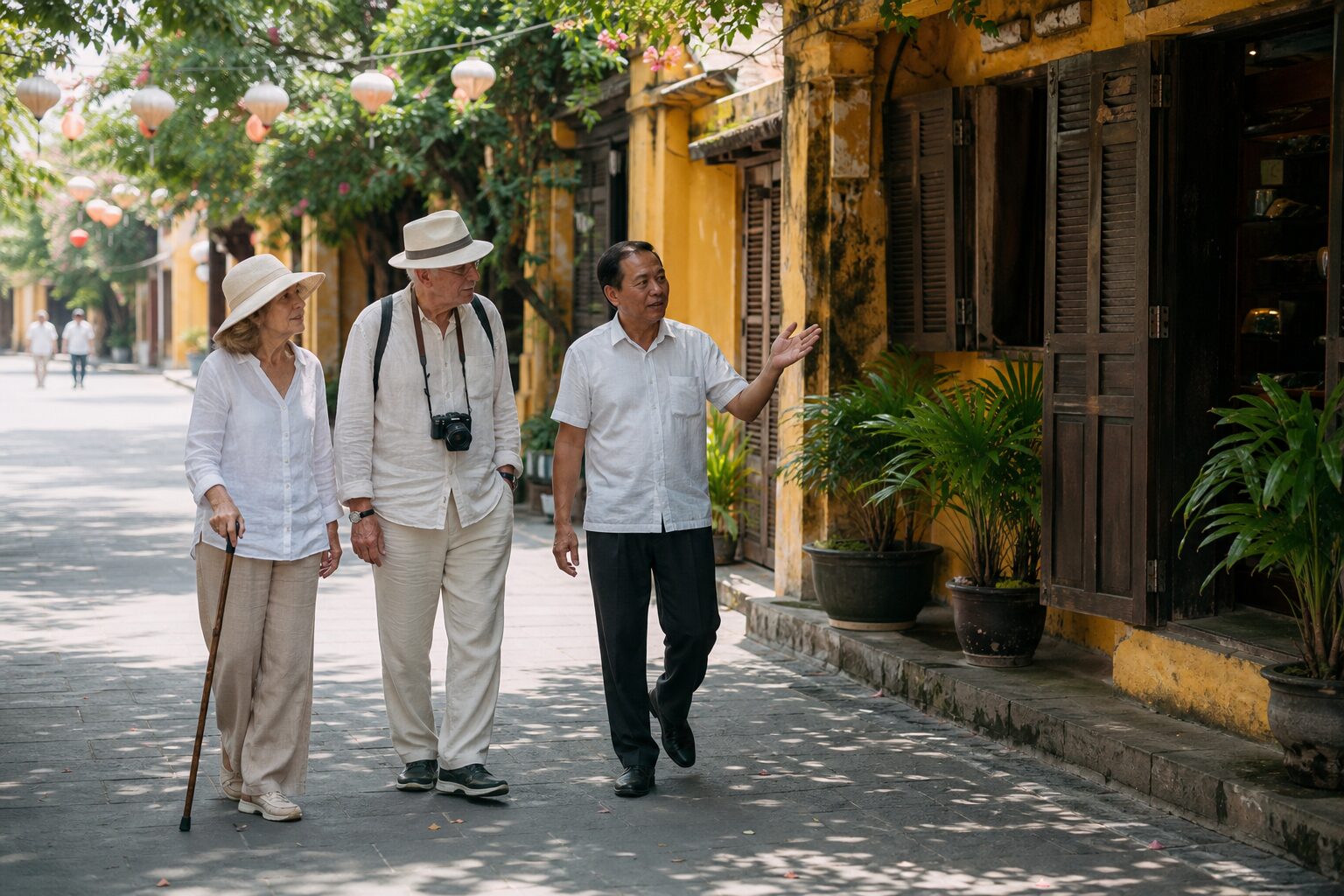
Easy. Hoi An old town is flat, shaded and pedestrianised through the middle of the day. The Mekong Delta is boats and level paths. Saigon’s central district is flat with wide pavements. Halong and Lan Ha Bay are almost entirely seated. Hue’s Imperial Citadel is large but level, and can be crossed by electric buggy. Most Hanoi museums and the Temple of Literature are manageable.
Moderate. Hanoi’s Old Quarter is flat but crowded, with uneven pavements and motorbikes parked across them — fine with a guide beside you, tiring alone. Ninh Binh’s rowing boats involve a low step down into the boat. Cu Chi tunnels can be visited without entering any tunnel.
Hard, and honestly so. The Marble Mountains near Da Nang are a long stone stairway. Hue’s royal tombs vary — some are level, others involve significant steps. Mua Caves in Ninh Binh is around 500 steps and is simply not worth attempting; the view from below is lovely and free. Angkor’s larger temples involve steep, uneven stone. Sapa trekking is real trekking.
None of this rules anything out. It changes which version of each place you do, and a guide who knows the alternatives is worth a great deal. There is more detail on the individual sites in this guide to Hue and its tombs and this Ninh Binh guide.
Heat, and why the month matters so much
Heat is the thing that catches people out, more than any physical challenge. Vietnam in June, July and August reaches the high thirties with heavy humidity in the centre and south, and that is genuinely hard work at any age.
October to April is the window. Within that, November to March is cool and dry in the north — pleasant walking weather, occasionally needing a jacket in Hanoi. The centre is comfortable from February to May. The south is dry and warm from November to April.
Whatever the month, the day should be built around the heat rather than through it: out early, back to the hotel between roughly noon and three, out again late afternoon when the light is better anyway. Our month-by-month guide covers each region, and the northern seasons in more detail.

Hotels: what to ask for that nobody thinks to ask
Star ratings tell you almost nothing about whether a hotel is comfortable for an older traveller. These are the things we check before booking, and the things worth specifying if you book yourself.
- A lift that reaches your floor. Many charming Vietnamese boutique hotels have four floors and no lift at all. This is the single most common problem.
- Walk-in shower rather than a step-over bath, and a grab rail if available.
- Ground-floor or low-floor rooms, and ideally a room near the lift rather than at the end of a long corridor.
- A genuine lobby to sit in. Somewhere to wait comfortably matters more than you would expect.
- Central location. Ten minutes’ walk from everything beats a better room twenty-five minutes out.
- Quiet side of the building. Vietnamese cities start early and are loud.
On the cruise, ask which deck the cabin is on and how many steps there are between the cabin and the dining room. On a smaller boat the answer is usually none, which is one reason we often suggest Lan Ha Bay over Halong for this kind of trip.
Getting around
Internal flights are the right choice over long drives, and Vietnamese domestic airports are manageable. Airport assistance and wheelchair service can be requested in advance and is reliable; we arrange it as a matter of course when asked.
Vehicles matter more than people realise. A seven-seat van for two people means a high, wide door and a proper step rather than folding yourself into a sedan. We specify this routinely for older clients and it costs almost nothing extra.
Cyclos and motorbike tours are worth a mention: cyclos are gentle and enjoyable; a motorbike food tour is fun but involves mounting and dismounting repeatedly, so decide honestly. The Hue to Da Nang train is a genuinely lovely three hours, seated the whole way, and a much better experience than the mountain road.
Health, medication and peace of mind
We are a tour operator and not doctors, so this is practical rather than medical.
Bring medication in original packaging with a copy of the prescription, in hand luggage, with more than the trip needs. Pharmacies in Hanoi, Da Nang and Ho Chi Minh City are excellent and inexpensive, and international-standard hospitals exist in all three cities. Travel insurance that includes medical evacuation is not optional at this age — check the upper age limit on the policy carefully, as many cut off at 70 or 75 and the cheap ones exclude pre-existing conditions.
Tell us anything relevant when we are building the trip: mobility, a knee that objects to stairs, a heart condition, dietary restrictions, how long you can comfortably walk. It changes the itinerary in ways that make it better, not smaller. Clients sometimes hold this back out of politeness and it is the one piece of information we most need.
Two itineraries we actually run
Twelve days, three bases, no rush. Four nights Hanoi (city, Ninh Binh day trip, a free day), two nights on a Lan Ha Bay boat, one flight to Da Nang, five nights near Hoi An with Hue as a day trip by train. Home from Da Nang. One internal flight, two hotel changes, and the whole centre and north seen properly.
Sixteen days, four bases, whole country. Hanoi and the bay as above, then Hoi An, then Saigon with the Mekong Delta, finishing with four nights on a Phu Quoc beach before the flight home. Two internal flights. The beach at the end is deliberate: it turns the long haul home into something you are rested for rather than dreading.
Both are adapted from routes on our site — the 11-day luxury route and the 15-day trip with beach — rebuilt with fewer moves and longer stays. If you have less time, the 5-day trip from Hanoi is a good slow week when stretched to seven nights.
Travelling with adult children and grandchildren
Multi-generational trips are one of the things we do most, and they are the case where private travel stops being a preference and becomes necessary. Three generations have irreconcilable schedules: the grandchildren want to be in the water, the middle generation wants to see everything, and the grandparents want a coffee and a sit down.
What works is one vehicle, one guide, and a plan that splits during the day and reconvenes for dinner. Beach-based sections help enormously, because everyone can do their own thing from the same base. Our guide to Vietnam with kids covers the family pacing side, and private versus group travel explains why a fixed coach itinerary tends to fail this group specifically.
What to skip without regret
Being decisive about this is what makes the rest of the trip good.
- Sapa, unless you specifically want the mountains and are content to look rather than trek. It is a long journey for scenery you can get closer to Hanoi.
- Mua Caves and other viewpoint climbs. Beautiful, and 500 steps.
- Ha Giang loop. Extraordinary, and days of mountain switchbacks.
- Dawn starts for sunrise, except where you genuinely want them. Angkor at sunrise is worth one early morning; a 5am market in Can Tho usually is not.
- Two-country trips under two weeks. Adding Cambodia to twelve days means a border, a flight and two more hotels.
If Angkor is on the list, give it three days rather than one and do the temples in the early morning only. Our guide to how long you need at Angkor sets out the difference, and Laos is worth considering as the gentler alternative — Luang Prabang is the most relaxed place in the region and nothing there requires a climb.
Talking to us about it
There is no separate “senior tour” product here, and we would be suspicious of a company that had one. What we do is build the same private trips with different pacing, different hotels and an itinerary that assumes afternoons off.
When you write to us, tell us the month, how long you have, how far you are happy walking in a day, whether stairs are an issue, and anything about health we should plan around. We will send back a real day-by-day plan with named hotels, and we will tell you plainly if something on your list is going to be a struggle rather than quietly including it and hoping.
You can reach us on WhatsApp or through the contact form. Costs are in our Vietnam trip cost breakdown, and if you are travelling from Australia the flight and timing detail is in Vietnam tours from Australia.
Frequently asked questions
Is Vietnam suitable for travellers in their seventies and eighties?
Yes, on a properly paced itinerary. Our oldest clients are in their late eighties. The changes that matter are fewer destinations with longer stays, hotels with lifts and walk-in showers, internal flights instead of long drives, and afternoons kept free. Distance is rarely the obstacle — heat, stairs and repeated early starts are.
How much walking is involved on a Vietnam tour?
On our itineraries for older travellers, typically one to two kilometres at a time with places to sit, and almost never more than three kilometres in a day. Hoi An, Hue’s citadel, central Saigon and the Mekong are all manageable at that level. We will tell you before booking which sites involve real climbing so you can choose.
Can you arrange wheelchair access and airport assistance?
Airport assistance and wheelchair service at Vietnamese airports can be requested in advance and works reliably. Full step-free travel is harder: Vietnam has limited accessible infrastructure, pavements are uneven, and many older buildings have no ramp. We can build a genuinely low-mobility itinerary using flat sites, boats and vehicle access, but we will be honest with you about which places will not work rather than promising everything.
What is the best time of year for older travellers to visit Vietnam?
October to April. November to March is cool and dry in the north and comfortable for walking; the south is dry and warm from November to April. Avoid June to August, when the centre and south are very hot and humid, and avoid Tet in late January or February when the country largely shuts down.
Are the Halong Bay cruises comfortable for older passengers?
Generally yes, but ask about the layout before booking. On smaller boats in Lan Ha Bay the cabins, dining room and deck are usually on one or two levels with few steps, and the tender transfer is a single low step. Larger Halong boats can mean stairs between decks. Kayaking and cave climbing are always optional, and the bay is best seen from a deck chair anyway.
Do we need travel insurance, and will it cover us at our age?
Take it, and read the age limits carefully. Many standard policies cap cover at 70 or 75, and cheaper ones exclude pre-existing conditions. Medical evacuation cover is the part that matters most. Specialist over-70 insurers exist in the UK, Australia and elsewhere, and cost more for good reason.
Is the food in Vietnam a problem for sensitive stomachs?
Less than most people fear. Vietnamese cooking is light, fresh and not heavily spiced, and rice, noodle soups and grilled dishes suit most people well. Drink bottled or filtered water, be sensible about raw herbs and shellfish in the first days, and let us know about restrictions so guides can order accordingly. Established restaurants and hotels are safe, including their ice.
Should we book a private tour or join a group at our age?
Private, in almost every case. The ability to go back to the hotel at two in the afternoon, skip a temple, add a rest day or spend an extra hour somewhere is the difference between enjoying the trip and enduring it. A group coach itinerary runs to a timetable that cannot accommodate any of that.
CTour DMC Vietnam — planning team
We are a licensed Destination Management Company based in Vietnam, designing private journeys across Vietnam, Cambodia and Laos since 2010. This guide was written by the planners and local guides who run these trips on the ground, and is reviewed against current conditions before publication. More about our team · Ask us a question
Published 21 September 2026 · 2,475 words · 11 min read