The short answer
- Thailand is easier. Vietnam is more interesting. That is the whole comparison in two sentences, and which one matters more to you decides it.
- Choose Thailand for a first trip to Asia, for a beach-led holiday, for a short trip, or if you want to travel independently with no planning.
- Choose Vietnam for landscape and history, for food, for a two-week journey with variety, and if you want somewhere that still feels unpolished.
- Costs are close. Vietnam is cheaper on the ground; Thailand has more competition on flights and hotels. Neither decision should be made on price.
- Vietnam is long and thin — it needs internal flights and a route. Thailand works as a hub with trips out.
- Thailand has better beaches. We are not going to pretend otherwise.
We are a Vietnamese operator. We sell Vietnam, Cambodia and Laos, and we do not sell Thailand, so treat everything below with that in mind. What follows is what we tell people who write to us genuinely undecided — including the cases where we tell them to book Thailand instead, which happens several times a month and costs us nothing worth keeping.
Both countries are excellent. Anyone who tells you one is objectively better is selling something. They are, however, good at noticeably different things, and matching that to the trip you actually want is easy once someone lays it out.
The real difference, stated plainly
Thailand has had mass international tourism for fifty years. The consequences run in both directions. Getting around is simple, English is widely spoken in tourist areas, standards are predictable, there is an island and a hotel for every budget, and you can plan the whole thing yourself in an afternoon. The cost is that the well-known places are busy and sometimes feel packaged — the famous beaches, the elephant attractions, the Bangkok tourist strip.
Vietnam opened up properly in the 1990s and tourism is younger here. It is more work — less English outside the cities, traffic that startles people, a country 1,650 kilometres long that needs an actual route rather than a base. What you get for that effort is a place where a normal street is still a normal street. The food is astonishing and cheap. The history is recent, complicated and present. The northern mountains have very few foreign visitors in them.
If your instinct on reading those two paragraphs was “I want the easy one” — that is a legitimate answer, not a lesser one. Book Thailand and have a wonderful time.
Food
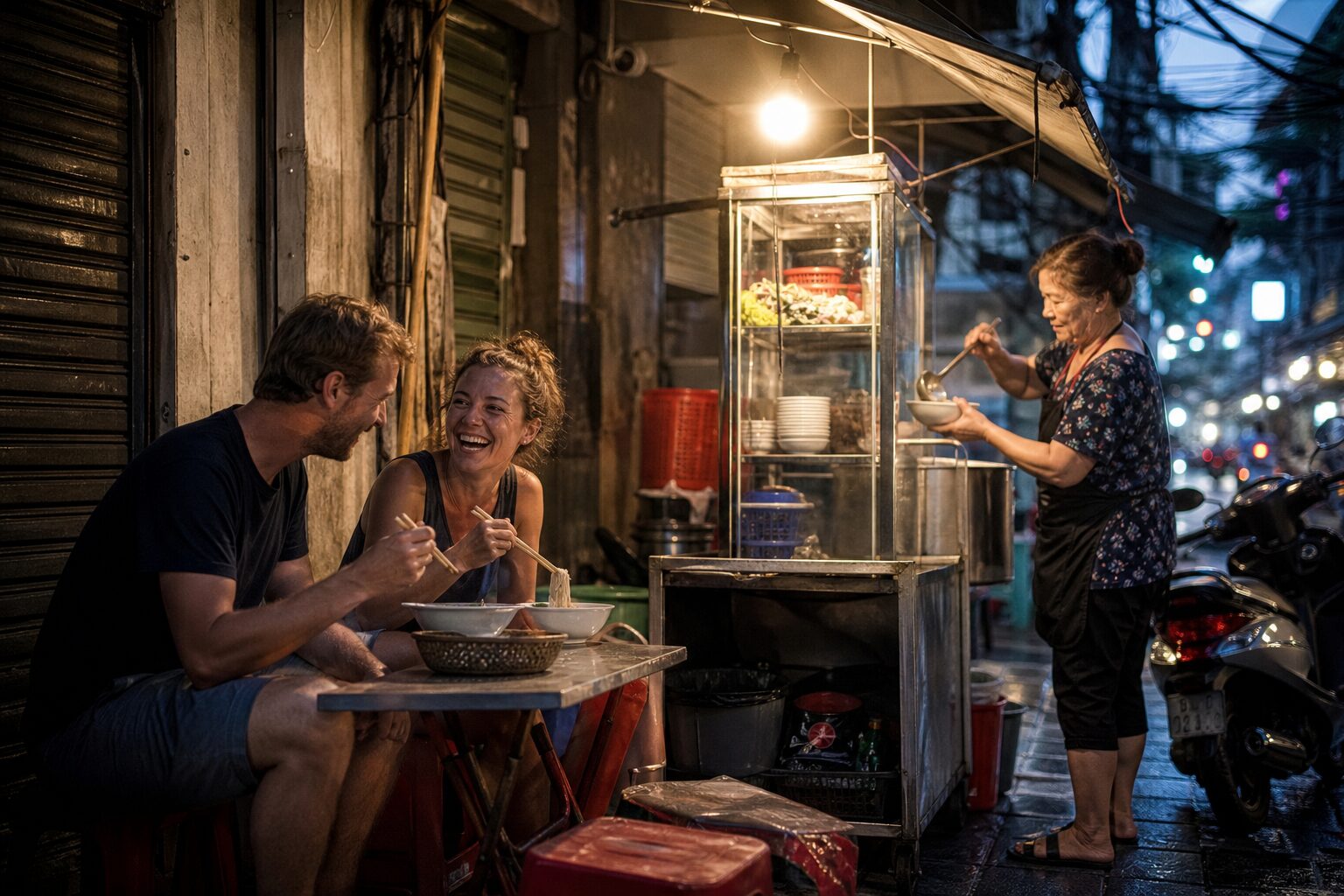
This is where we will make the strongest claim and defend it: Vietnam is the better eating country, and it is not close.
Thai food is bolder — chilli, coconut, lemongrass, punchy curries — and the best of it is superb. But Vietnamese cooking has more range and more regional variation. Northern food is subtle and broth-led. Hue’s imperial cooking is the most refined in the country and almost unknown abroad. Central Vietnam is herb-heavy. The south is sweeter and more tropical. Eating your way from Hanoi to Saigon is genuinely like travelling through four cuisines.
It is also lighter, which matters more than people expect over two weeks, and easier on people who do not want heat in every dish. A bowl of pho on a street corner is US$2. A very good restaurant dinner in Hanoi is US$25 a head with drinks.
Thailand wins on one point here: vegetarians and vegans have a far easier time, and Thai kitchens are used to adapting dishes. Vietnamese cooking uses fish sauce and pork stock almost by default, so it takes more effort — possible, but it needs a guide who can ask the right questions.
Beaches
Thailand wins. Plainly and by a distance.
Krabi, Koh Lanta, Koh Samui, Phuket’s better beaches — the limestone-and-turquoise combination in southern Thailand is world-class, the beach hotel stock is deeper at every price point, and the islands are set up for the kind of holiday where you do nothing for a week.
Vietnam has good beaches, not great ones. Phu Quoc is genuinely lovely and improving fast. An Bang near Hoi An is pleasant and useful because it is twenty minutes from a heritage town. Con Dao is beautiful and barely visited. Nha Trang is busy and built up. Da Nang has a long clean city beach. What Vietnam does not have is a Thai-island equivalent, and the weather is more awkward — the central coast has a real typhoon and rain season from roughly September to December, so beach time has to be planned around it.
So: if the trip is mainly a beach holiday with a bit of culture attached, Thailand is the better buy. If it is mainly a journey with three or four days of beach at the end to recover, Vietnam handles that well — that is exactly the shape of our fifteen-day trip with beach time.
Landscape and cities
Vietnam wins on landscape, and it is the reason most of our repeat clients come back.
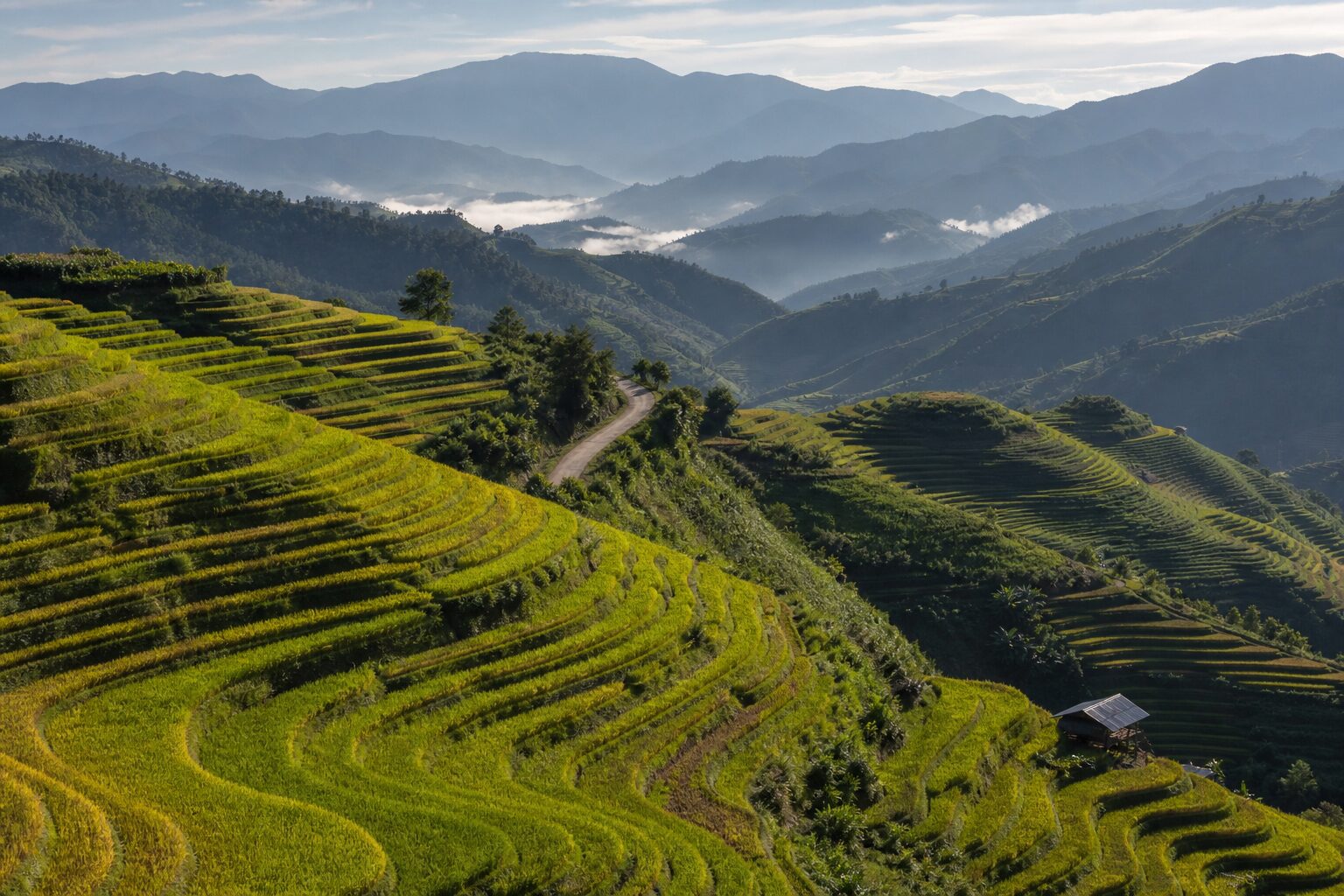
The limestone bays — Halong, and the quieter Lan Ha next door — have no real Thai equivalent. The northern mountains around Sapa, Ha Giang and Mu Cang Chai are terraced rice on a scale that photographs badly because no lens gets the whole thing. Ninh Binh is Halong Bay’s rock formations on a river, and you row through it. The Mekong Delta is a working landscape of canals and floating markets. Northern Thailand around Chiang Mai and Pai is attractive but gentler and more forested.
On cities it is closer. Bangkok is one of Asia’s great cities — bigger, wilder, with better nightlife, better shopping and a more sophisticated restaurant scene than anything in Vietnam. Hanoi is smaller, older and more atmospheric, and the Old Quarter is the single most absorbing place to walk in either country. Ho Chi Minh City is energetic and modern with the best coffee culture in Southeast Asia. Chiang Mai is the most relaxed of all four.
History and what you learn
Different rather than better, but worth being specific about.
Thailand offers Buddhist temple architecture at the highest level — Ayutthaya, Sukhothai, the Bangkok royal temples — and, unusually in the region, a history with no colonial period. It was never occupied by a European power, and that shows in the confidence of the culture.
Vietnam’s history is louder and more recent. There is a thousand years of Chinese influence, then French colonisation, then the wars — with France, then America, then Cambodia. You can visit the tunnels, the DMZ, the prisons and the war museums, and be given a version of the twentieth century that differs sharply from the one you grew up with. Travellers from the US and Australia in particular tend to find this the most affecting part of the trip, whatever they expected. Add Cambodia and you can put Angkor, the greatest temple complex in Asia, on the same route — our guide to how long you need at Angkor covers that.
Cost
Closer than the internet suggests. Vietnam is cheaper day to day — food noticeably so, mid-range hotels somewhat, guides and drivers clearly. Thailand has more airline competition on long-haul routes and a deeper hotel market, which often cancels the difference out.
Practically: a two-week private trip with good four-star hotels, private guide and driver, and internal flights runs roughly US$2,000–2,600 per person in Vietnam based on two sharing. An equivalent Thailand trip is usually 10–20% more, mostly on beach-resort rates. At the budget end Thailand is easier to do cheaply because the infrastructure exists; at the top end both have properties at any price you like. Our Vietnam trip cost breakdown has the component-by-component numbers, and why two quotes differ so much explains what to check before comparing totals.
Do not choose on cost. The difference across a two-week trip is smaller than the difference between a good itinerary and a bad one.
Ease of travel
Thailand wins, clearly.
Bangkok is a genuine hub with a metro, trains and cheap flights everywhere. English is widely spoken in tourist areas. Road quality is good. Islands are connected by frequent, easy ferries. Self-driving is realistic in places. A first-time visitor to Asia can land, work it out and be fine.
Vietnam is more demanding. It is a long thin country, so a two-week trip needs one or two internal flights and a deliberate route — you cannot base yourself in one spot. Traffic in Hanoi and Saigon is genuinely intimidating at first. English drops off quickly outside hotels and tourist businesses. Trains are charming and slow; this guide to Vietnamese trains covers where they are actually the better option.
This is the honest reason a larger share of Vietnam travellers use a local operator: not because it cannot be done independently — plenty do it well — but because the planning genuinely takes work, and a bad route wastes days. In Thailand, winging it works. We wrote about the mechanics of this in private tour or group tour.
When to go
Thailand is simpler. November to March is dry and pleasant nearly everywhere, with the Andaman coast best from November to April and the Gulf islands running a slightly different pattern that keeps Koh Samui good into July.
Vietnam has no single good season, because the country spans too much latitude. North: cool and dry November to March, hot and wet May to September. Centre: dry February to August, with heavy rain and typhoons September to December. South: dry November to April. The best compromise windows are roughly February to April and October to November, when most of the country works at once. Full detail is in our month-by-month guide, plus a regional view in this northern Vietnam seasons guide.
If your dates are locked to July or August, that is a real argument for Thailand’s Andaman coast or for northern Vietnam only — the centre and south in high summer are hard work.
So which one
Book Thailand if: it is your first time in Asia and you want it easy; the beach is the main event; you have a week or less; you want to travel independently without planning; you are travelling with teenagers who will want nightlife and water sports; you are vegetarian and do not want a daily negotiation; or your dates are fixed in June to August.
Book Vietnam if: you want landscape and history over resorts; food is a main reason you travel; you have two weeks or more and want a journey with variety; you have been to Thailand already; you want somewhere that still feels unfinished; you are interested in the twentieth century; or you want to add Cambodia or Laos on the same trip.
And the option nobody suggests: do both, in that order. Two weeks is not enough for both countries — three is workable, with a week in northern Thailand and ten days in Vietnam, flying Bangkok to Hanoi in under two hours. But the pattern we see most often is people who did Thailand five years ago, came to Vietnam next, and now come back to us for Cambodia and Laos. Thailand is the easier introduction. Vietnam is what you do when Asia has your attention.
Talking to us about it
If you are genuinely torn, write to us and say so. Tell us your dates, how long you have, whether the beach matters, and whether this is your first trip to the region. If the answer is Thailand we will tell you, and we will tell you why — we would rather do that than sell you two weeks of the wrong country and read about it afterwards.
If it is Vietnam, we will send back a real day-by-day route with named hotels. Our eleven-day itinerary is the most common starting point, and there is a short five-day route from Hanoi for people adding Vietnam to a longer Asia trip. Reach us on WhatsApp or through the contact form.
Frequently asked questions
Is Vietnam or Thailand better for a first trip to Southeast Asia?
Thailand, for most people. It is easier to travel independently, more English is spoken in tourist areas, standards are more predictable and Bangkok is a genuine transport hub. Vietnam rewards you more if you are willing to plan a route or use a local operator, but it is the harder first trip — a long thin country that needs internal flights and a deliberate itinerary.
Which is cheaper, Vietnam or Thailand?
Vietnam is cheaper on the ground, especially food, guides and drivers. Thailand often closes the gap through cheaper long-haul flights and a more competitive hotel market. A two-week private trip with good four-star hotels is roughly US$2,000–2,600 per person in Vietnam based on two sharing, typically 10–20% more in Thailand. The difference is small enough that it should not decide the trip.
Does Vietnam or Thailand have better beaches?
Thailand, clearly. Krabi, Koh Lanta and Koh Samui are world-class, and the beach hotel stock is deeper at every price point. Vietnam’s best are Phu Quoc, Con Dao and An Bang near Hoi An — good, not great, and the central coast has a genuine typhoon season from September to December. For a beach-led holiday, choose Thailand. For a journey with a few days of beach at the end, Vietnam works well.
Is the food better in Vietnam or Thailand?
Vietnam, in our view, on range and regional variation rather than intensity. Northern broths, Hue’s imperial cooking, the herb-heavy centre and the sweeter south are effectively four cuisines on one route, and the food is lighter over a two-week trip. Thailand is bolder and much easier for vegetarians and vegans, since Vietnamese cooking uses fish sauce and pork stock by default.
Can I visit Vietnam and Thailand on the same trip?
Yes, and flights between Bangkok and Hanoi or Ho Chi Minh City take under two hours and are inexpensive. Three weeks is the sensible minimum — roughly a week in Thailand and ten to twelve days in Vietnam. In two weeks you would spend too much of the trip in transit and see neither country properly.
Is Vietnam safe compared to Thailand?
Both are safe for travellers, with low rates of violent crime against visitors. In both, the realistic risks are road traffic, petty theft in crowded areas and scams around transport and tours. Vietnamese city traffic feels more intimidating at first. Thailand has more alcohol-related incidents and motorbike accidents in the party destinations. Neither should worry you.
How many days do I need in Vietnam?
Ten days minimum for the north and centre, fourteen for a proper north-to-south route, and three weeks if you want to add Cambodia or Laos. Under a week, pick one region rather than trying to cover the country — Hanoi with the bay, or Hoi An and the centre, both work well as a short trip.
Is Thailand or Vietnam better for families with children?
Thailand for younger children and for a first family trip to Asia: shorter transfers, resort infrastructure built around kids, calmer beaches and simpler logistics. Vietnam suits families with children over about eight, where the variety — boats, caves, cooking classes, cycling in Hoi An — holds attention better than a week on a beach. Our guide to Vietnam with kids covers the practical side.
CTour DMC Vietnam — planning team
We are a licensed Destination Management Company based in Vietnam, designing private journeys across Vietnam, Cambodia and Laos since 2010. This guide was written by the planners and local guides who run these trips on the ground, and is reviewed against current conditions before publication. More about our team · Ask us a question
Published 23 September 2026 · 2,649 words · 12 min read