The short answer
- Cambodia is a destination. Vietnam is a journey. Angkor is the reason people go to Cambodia, and it is worth the flight on its own. Vietnam is 1,650 kilometres of changing landscape, food and history.
- Choose Cambodia if you have under a week, if temples and archaeology are the point, or if you want one unforgettable place rather than a route.
- Choose Vietnam if you have ten days or more, if you want variety, if food is a main reason you travel, or if you want mountains, cities and coast in one trip.
- Do not choose, if you can help it. Two weeks covers Vietnam plus Angkor comfortably, and the flight between them is an hour. This is what most of our clients actually book.
- Cambodia is slightly more expensive day to day than people expect, mainly because of Angkor passes, guides and the US dollar economy.
- Vietnam has far better food, hotels and infrastructure. Cambodia has the better single monument and, outside Siem Reap, fewer people.
We are a Vietnamese operator and we run trips in Vietnam, Cambodia and Laos, so unlike the Vietnam-versus-Thailand question we have no reason to push you one way here. Both countries are on our own itineraries. What follows is what we tell people who write in genuinely undecided, including the fairly common case where we say Cambodia and nothing else.
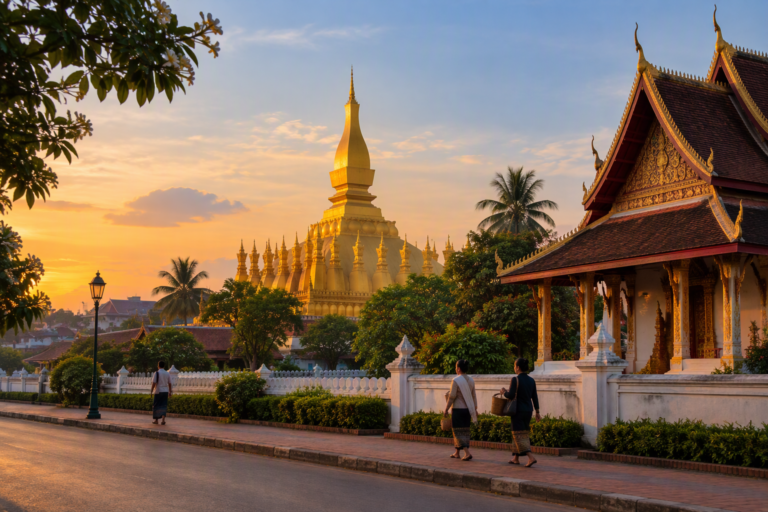
The honest framing is this: these two countries are not really competitors. Cambodia is one extraordinary place plus a handful of good ones. Vietnam is a long country with four or five distinct regions. The question is not which is better but which shape of trip you want.
What you actually go to Cambodia for
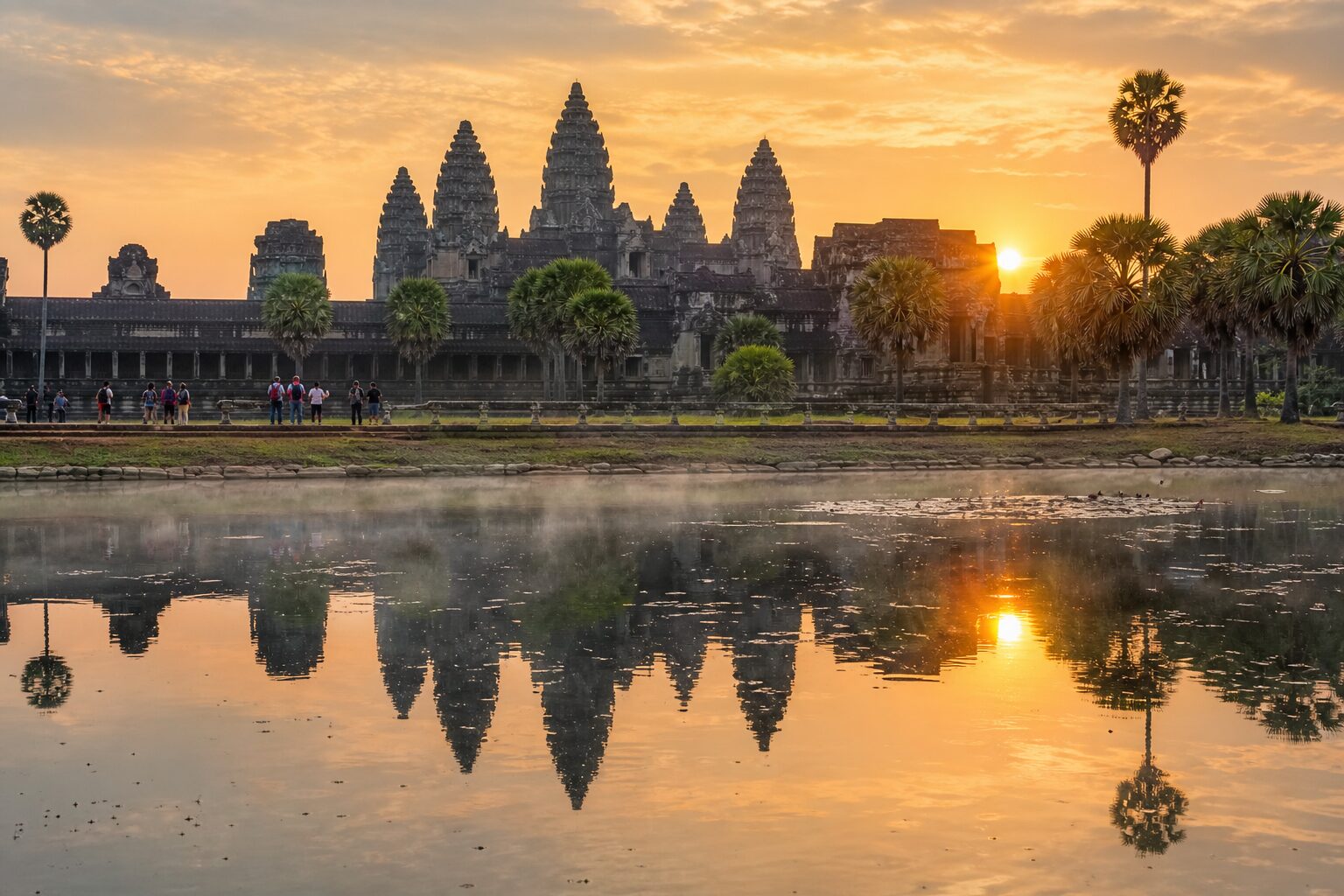
Angkor. Let us not be coy about it.
The Angkor Archaeological Park outside Siem Reap covers around 400 square kilometres and holds the remains of a capital that was, in the twelfth century, one of the largest cities on earth. Angkor Wat itself is the biggest religious monument ever built. Bayon has 200-odd carved stone faces watching you from every angle. Ta Prohm is the one with the trees growing through the masonry. The bas-reliefs at Angkor Wat run for hundreds of metres and depict a mythology most visitors have never encountered.
Nothing in Vietnam is on this scale. Vietnam’s historic architecture is beautiful and human-sized — the Hue citadel, the Hoi An merchant houses, the Cham towers at My Son. Angkor is a different category of thing, and if ancient civilisations are why you travel, that decides it before any other consideration.
Beyond Angkor, Cambodia offers Phnom Penh, which is a genuinely interesting and difficult city, with the Royal Palace, the National Museum and the two Khmer Rouge sites that most visitors find unforgettable and harrowing in equal measure. There is the south coast around Kep and Kampot, quiet and low-rise with pepper farms and crab markets. There are the islands off Sihanoukville, some lovely and some overdeveloped. And Battambang, a river town with colonial-era streets and almost no tour groups.
Our guide to how many days Angkor really needs goes into the temple planning in detail, because that is the single decision that most affects whether a Cambodia trip works.
What you actually go to Vietnam for
Range. Vietnam’s advantage is that a two-week trip feels like four holidays.
The north gives you Hanoi, which is the most atmospheric city in Southeast Asia and not a close contest, plus limestone seascapes at Halong and Lan Ha, the rice terraces and ethnic minority markets around Sapa and Ha Giang, and the flat-water karsts of Ninh Binh. The centre gives you the imperial city of Hue, the lantern-lit trading town of Hoi An, and beaches at Da Nang. The south gives you Ho Chi Minh City, which is fast, commercial and completely unlike Hanoi, plus the waterways of the Mekong Delta and island beaches at Phu Quoc and Con Dao.
Then there is the food, which is the thing our clients talk about most on the way home. Vietnamese cooking has real regional variation — northern broths, Hue’s imperial dishes, the herb-heavy centre, the sweeter south — and it is astonishingly cheap. Khmer food is underrated and worth exploring, particularly the fish amok and the sour soups, but it does not have the same depth or the same street-eating culture. This is not a close comparison either.
The twentieth century is also more present in Vietnam, and more legible. If the war is part of why you are coming, both countries have that history, but Vietnam’s is more thoroughly interpreted for visitors.
Cost: the surprising part
Most people assume Cambodia is cheaper. On the ground it usually is not, for three reasons.
First, the Angkor pass is a real expense: US$37 for one day, US$62 for three days and US$72 for a week, per person, and you want at least the three-day pass. Second, Cambodia runs largely on US dollars, and dollar pricing tends to round upwards. Third, Siem Reap is a concentrated tourism town where a good guide, a driver and a decent hotel cost roughly what they do in Hanoi, but you are paying for them in a place with fewer alternatives.
Vietnam is cheaper for food, drinks, massages, local transport and mid-range hotels. It is also a much deeper hotel market — at every price point from US$40 to US$400 a night, Vietnam simply has more and better choices, particularly outside the main cities.
For a private, guided trip with good four-star hotels, our rough working numbers are US$160–220 per person per day in Vietnam and US$180–250 in Cambodia, based on two people sharing, excluding international flights. Cambodia’s higher figure is mostly Siem Reap. Our breakdown of what a Vietnam trip costs sets out where the money goes, and the same logic applies across the border. If you are comparing quotes from several companies, it is worth understanding why two prices for the same trip can differ by forty percent.
Ease of travel and infrastructure
Vietnam is noticeably easier once you are moving. Domestic flights are frequent and cheap, the north-south rail line works and is a pleasant way to cover distance, the main roads are decent, and hotels in the mid and upper range are held to standards visitors recognise. There is a good overview of Vietnam’s train routes and classes if that appeals.
Cambodia is smaller, which helps, but the internal network is thinner. Siem Reap to Phnom Penh is a five to six hour drive or a short flight. Roads to the coast and to Battambang are slower than the map suggests. Outside Siem Reap and the capital, hotel quality drops off faster than in Vietnam, and English is less widely spoken.
Neither country is difficult with a driver and a guide. Independently, Vietnam gives you more options and more margin for error.
Crowds
This one cuts both ways and is worth being precise about.
Angkor Wat at sunrise is genuinely crowded — hundreds of people at the reflecting pool, phones up. That is avoidable with planning: go to Angkor Wat in the afternoon instead, take Bayon or Ta Prohm at dawn, and use the outer temples like Banteay Srei and Beng Mealea, which are quiet most of the day. A guide who knows the rhythm of the park is worth more in Siem Reap than almost anywhere else we operate.
Vietnam’s headline sights are also busy — central Hoi An in the evening, the main Halong Bay routes, Sapa town on a weekend. But Vietnam is large enough to have genuine escape valves. Ha Giang, Mai Chau, Con Dao, Phong Nha and most of the Mekong Delta away from the standard day trip are still quiet. Cambodia outside Siem Reap is also quiet, but there is simply less of it to go to.
Beaches
Vietnam wins on range, Cambodia on emptiness.
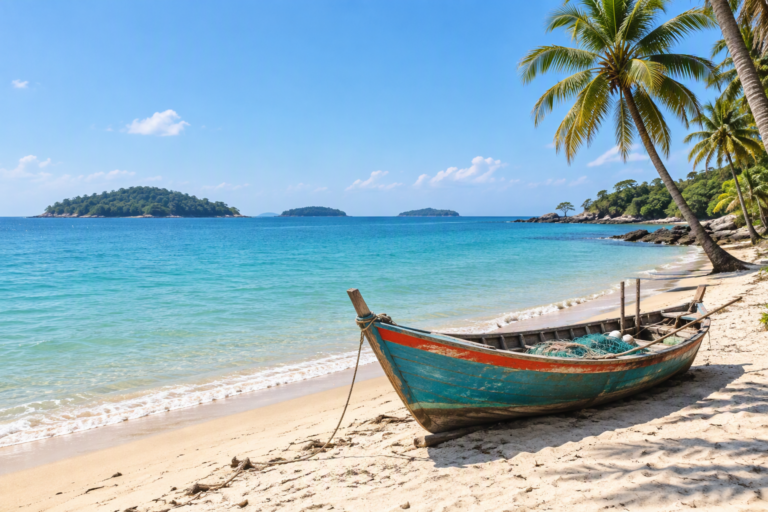
Phu Quoc has the deepest hotel supply of any beach destination in either country, an hour’s flight from Saigon, and is at its best from November to April. Con Dao is the quieter Vietnamese option, a former prison island turned national park with nesting sea turtles. Da Nang and An Bang near Hoi An work well as a few days tacked onto a cultural route. Our guide to the best beaches in Vietnam covers the choice properly.
Cambodia’s coast is lower-key. Kep and Kampot are charming and not really beach destinations — they are river, pepper farm and seafood destinations. Koh Rong and the smaller islands have beautiful sand and patchy infrastructure. If a good beach week is central to the trip, neither country is Thailand, and Vietnam is the safer bet of the two.
When to go, and where the seasons disagree
Cambodia is simpler. November to March is dry, pleasant and the peak season. April and May are extremely hot, often 38°C and above at the temples, which is genuinely punishing. June to October is the green season, with afternoon rain, dramatic skies, full moats and far fewer people — and it is our own favourite time at Angkor, with the caveat that some outer roads get difficult.
Vietnam is more complicated because it spans several climates at once. Northern Vietnam has a cold, misty winter and a hot, wet summer. Central Vietnam has a distinct typhoon and flood season from roughly September to December. The south is warm year-round with a wet season from May to October. Our month-by-month guide to the best time to visit Vietnam lays this out region by region.
For a combined trip, the overlap that works best is November to March, and within that, November, December, February and March are the sweet spot — dry in Cambodia, clear in central Vietnam, cool but bright in the north. January can be genuinely chilly in Hanoi. Watch out for Tet in Vietnam and Khmer New Year in mid-April, both of which change how the countries operate for several days.
The case for doing both, which is what we usually recommend
The flight from Hanoi or Ho Chi Minh City to Siem Reap takes around an hour and a half and costs very little. There is no practical reason to fly halfway around the world to visit one and not the other, unless your holiday is genuinely short.
Our standard advice on timing. Under seven days: pick one. Cambodia if you want Angkor; one Vietnamese region if you want Vietnam. Ten to twelve days: Vietnam plus three nights in Siem Reap is comfortable and is the most common thing we book. Fourteen days: both countries properly, with Phnom Penh included or a beach finish. Three weeks: add Laos, which is the quietest of the three and the one people are most surprised by.
The usual sequence runs north to south through Vietnam and finishes with Angkor, so that the trip ends on its single biggest sight. Some clients prefer the reverse, getting the temples done while their energy is highest. Both work. What does not work is sandwiching a two-night Angkor stop in the middle of a packed Vietnam route, which costs you two travel days and does the temples a disservice.
Our two-week Vietnam and Cambodia itinerary sets out the day splits we actually use, including how many nights Angkor needs and whether to include Phnom Penh. If you would rather see the commercial version, the ten-day Angkor and southern Vietnam tour is the shortest combination we are happy to sell, and the eleven-day Vietnam route is what most people extend with a Siem Reap add-on.
Practical differences worth knowing before you book
Visas. Both countries require most nationalities to arrange something, but the systems differ and change periodically. Vietnam’s e-visa process is covered in our Vietnam visa and entry guide. Cambodia issues an e-visa and also a visa on arrival at the main airports. If you are doing both countries, note that you need entries for each, and that leaving and re-entering Vietnam consumes an entry on a single-entry visa.
Money. Cambodia uses US dollars for almost everything, with Cambodian riel functioning as small change — you will get riel back from a dollar note. ATMs dispense dollars. Vietnam uses dong only, and the note denominations catch people out; our guide to money and tipping in Vietnam covers that and the tipping norms, which are broadly similar in Cambodia.
Heat and walking. Angkor is a walking, climbing, stair-heavy experience in high heat with limited shade. It is harder physically than anything on a standard Vietnam itinerary. If mobility or heat tolerance is a concern, that matters more than any other factor here, and it can be planned around with early starts, a shorter temple list and a properly paced route — we wrote about that approach in our guide to slower itineraries for older travellers.
Safety. Both are safe countries for visitors, with traffic and petty theft as the realistic risks rather than anything violent. Our honest answer on whether Vietnam is safe applies fairly well to Cambodia too, with the addition that rural Cambodia still has landmine risk in specific areas — stay on marked paths and do not wander off trail in the northwest.
So which should you book?
Book Cambodia alone if: you have under a week; Angkor is the actual reason for the trip; you want one place rather than a route; you have already done Vietnam; or you want to combine with Thailand, which is an easy and common pairing.
Book Vietnam alone if: you have ten to fourteen days and want variety; food is a main reason you travel; you want mountains, cities and coast on one trip; you are travelling with children who need changes of scene; or you want the more comfortable, better-serviced trip.
Book both if you have twelve days or more, which is most people, and which is why the combined trip is the single most common thing we plan.
If you are still undecided, tell us your dates, how long you have and what you most want out of the trip, and we will come back with a real day-by-day plan and named hotels rather than a brochure. Reach us on WhatsApp, through the contact form, or call Mr Phuong on +84 913 833 980.
For the on-the-ground detail of the Vietnamese side, there are useful companion guides to Ho Chi Minh City, Hoi An and the Mekong Delta, plus a rundown of the Hanoi dishes worth seeking out.
Frequently asked questions
Is Vietnam or Cambodia better to visit?
They suit different trips. Cambodia is the choice if Angkor is the reason you are travelling or if you have under a week, because it is one extraordinary destination rather than a route. Vietnam is better for a ten to fourteen day trip with variety — mountains, cities, coast and four distinct regional cuisines. With twelve days or more, most travellers should do both, since the flight between them takes about ninety minutes.
Is Cambodia cheaper than Vietnam?
Usually not, despite the assumption. The Angkor pass costs US$37 for one day, US$62 for three and US$72 for a week per person, Cambodia runs on US dollars which rounds prices upward, and Siem Reap is a concentrated tourism market. Vietnam is cheaper for food, drinks, local transport and mid-range hotels, and has a far deeper hotel market at every price point.
How many days do I need for Vietnam and Cambodia together?
Twelve days is the realistic minimum for both: around eight or nine nights in Vietnam covering two regions, plus three nights in Siem Reap. Fourteen days lets you do Vietnam north to south properly and add Angkor without rushing, and also allows Phnom Penh or a beach finish. Under seven days, choose one country rather than splitting.
Which has better food, Vietnam or Cambodia?
Vietnam, clearly. Vietnamese cooking has genuine regional depth — northern broths, Hue’s imperial dishes, the herb-heavy centre and the sweeter south — plus one of the world’s great street-eating cultures at very low prices. Khmer food is underrated and worth exploring, especially fish amok and the sour soups, but it has less variety and a thinner street-food scene.
When is the best time to visit Vietnam and Cambodia on one trip?
November to March, and within that November, December, February and March are best: dry in Cambodia, clear in central Vietnam and bright if cool in the north. April and May are punishingly hot at Angkor. Avoid the days around Tet in Vietnam and Khmer New Year in mid-April, when both countries partly shut down.
How do you travel between Vietnam and Cambodia?
Flying is the sensible option. Hanoi or Ho Chi Minh City to Siem Reap takes about ninety minutes and fares are low. Overland from Ho Chi Minh City to Phnom Penh via the Bavet border is possible in six to seven hours by bus or private car and can be interesting, but it consumes most of a day. If you are on a single-entry Vietnamese visa, remember that leaving and returning uses up your entry.
How many days do you need at Angkor?
Three days with a three-day pass is the sensible answer for most people, spread over four or five calendar days so you are not at the temples every morning. One day covers Angkor Wat, Bayon and Ta Prohm and is enough if time is very short. Five days suits anyone genuinely interested in Khmer history, adding outer sites like Banteay Srei, Beng Mealea and the Roluos group.
Is Cambodia safe for tourists?
Yes, broadly, with the same realistic risks as Vietnam: road traffic, petty theft such as bag snatching in Phnom Penh, and overcharging rather than anything violent. Two Cambodia-specific points: heat and sun exposure at the temples are a genuine hazard, so start early and carry water, and landmine risk persists in specific rural areas of the northwest, so stay on marked paths and do not walk off trail.
CTour DMC Vietnam — planning team
We are a licensed Destination Management Company based in Vietnam, designing private journeys across Vietnam, Cambodia and Laos. This guide was written by the planners and local guides who run these trips on the ground, and is reviewed against current conditions before publication. More about our team · Ask us a question
Published 29 September 2026 · 3,000 words · 14 min read