The short answer
- Vietnam is one of the easiest countries in Asia to get online. Data is cheap, 4G is fast almost everywhere, and free Wi-Fi is close to universal.
- Pick Viettel if your trip goes anywhere rural or mountainous. Vinaphone and Mobifone are just as good in the cities and along the coast.
- A tourist SIM with a generous data allowance costs roughly 150,000–300,000 dong — about US$6–12 — for 30 days. That is not a typo.
- eSIM works on all three networks if your phone is unlocked and eSIM-capable. It is the least hassle, and you can activate before you land.
- Bring your passport. Vietnamese law requires every SIM to be registered to an identity document, and the shop does it at the counter.
- Buy at a brand store — Viettel Store, FPT Shop, Mobile World — or at the official airport counters. Avoid loose SIMs sold from unmarked street stalls.
- Nothing is blocked. Google, Facebook, Instagram, WhatsApp and Messenger all work normally. Vietnam is not China in this respect.
- Signal drops in a small, predictable list of places: deep in the caves at Phong Nha, parts of the Ha Giang loop, remote trekking valleys, the outer islands and a few stretches of the Mekong backroads.
We are a Vietnamese tour operator, and this is one of the first practical questions clients raise once the itinerary is agreed. It is also one of the questions where the honest answer is reassuring: connectivity in Vietnam is cheap, fast and far less complicated than most visitors expect. What follows is what we tell clients, including the parts that nobody selling you a travel eSIM will mention.
The three networks, and which one to pick
Vietnam has three networks that matter: Viettel, Vinaphone (the VNPT brand) and Mobifone. A fourth, Vietnamobile, is cheaper and much weaker outside the cities, and we do not recommend it to visitors.
In Hanoi, Ho Chi Minh City, Da Nang, Hoi An, Hue, Nha Trang and along the main coastal corridor, all three are genuinely good. You will get fast 4G almost everywhere and 5G in the central districts of the big cities, where it has been rolling out steadily.
The difference shows up once you leave the flat, populated parts of the country. Viettel has the widest rural and mountain coverage by a clear margin — it is the network that reaches the high valleys of the north, the small coastal towns and the deeper parts of the Mekong Delta. If your trip includes Sapa, Ha Giang, Pu Luong, Mai Chau, the Central Highlands or island time, take Viettel and stop thinking about it.
If you are staying on the standard Hanoi–Hue–Hoi An–Ho Chi Minh City route, any of the three will do and you should simply take whichever the shop in front of you sells.
Physical SIM or eSIM?
Both work well here, and the right answer depends on your phone rather than on Vietnam.
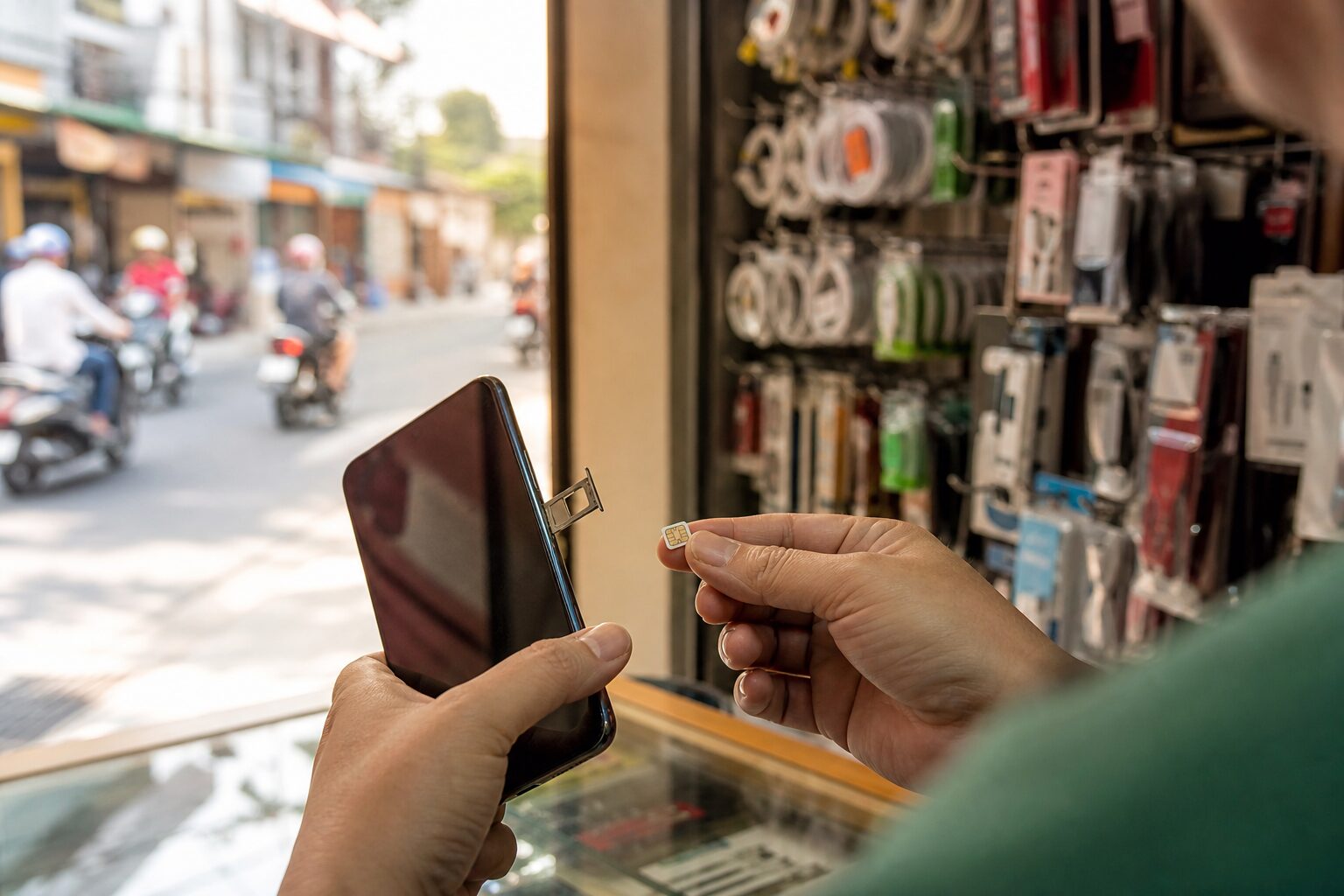
An eSIM is the least friction if your handset supports it and is not carrier-locked. All three major networks sell eSIM profiles, and so do the international travel-eSIM companies. You can buy and install before you fly, land with data already working, and keep your home number live for banking codes and messages. For most travellers with a recent iPhone or a flagship Android, this is what we suggest.
A physical SIM still has real advantages. It is usually cheaper for the same allowance, it gives you a Vietnamese phone number that actually receives calls and local SMS, and if anything goes wrong you can walk into a shop and have a human fix it in five minutes. That last point matters more than people expect.
Why a local number is genuinely useful: Grab drivers ring you when they cannot find you, restaurants confirm bookings by phone, and your guide or driver wants a number that works when you are twenty minutes late at a temple gate. A data-only eSIM leaves you reachable only through the internet, which is fine until you are standing in a car park with a driver circling the wrong block.
The practical compromise, and what a lot of our clients end up doing: keep your home SIM in the phone for your own number, and add a Vietnamese eSIM or a local SIM in the second slot for data. If your phone takes two SIMs in any combination, use both.
Two caveats on eSIM. Your phone must be unlocked — a handset tied to a home carrier will refuse the profile. And install it while you still have Wi-Fi, ideally at home or at the airport before departure, because activating an eSIM usually needs an internet connection you do not yet have.
What it costs, and what you actually get
This is the part that surprises people. Mobile data in Vietnam is among the cheapest in the world.
A typical tourist package runs 150,000–300,000 dong for 30 days — roughly US$6–12 — and includes a data allowance most visitors cannot exhaust: commonly several gigabytes per day, or a large monthly bucket, often with domestic calls and texts thrown in. Shorter 7-day and 15-day packages exist and cost proportionally less, though the saving is small enough that the 30-day option is usually the sensible buy even on a two-week trip.
Travel eSIMs bought from international resellers before you fly typically cost two to four times the local price for the same data. That premium buys convenience and an English-language app, which is a fair trade for some people — just know that is what you are paying for. The reseller is renting capacity on Viettel, Vinaphone or Mobifone either way.
Prices and package structures change, so treat the numbers above as the shape of the market rather than a quote. To see how this sits against everything else on a trip, our breakdown of what a Vietnam trip costs puts connectivity in context: it is one of the few line items where you can stop optimising, because the whole month costs less than a taxi to the airport at home.
Topping up, if you somehow need to, is easy. Brand stores and phone shops do it over the counter, most convenience stores sell top-up, and the network apps take a foreign card. Ask the shop that sold you the SIM to show you the balance-check code before you leave — it takes ten seconds and saves a puzzle later.
Where to buy, and where not to
At the airport. Noi Bai in Hanoi, Tan Son Nhat in Ho Chi Minh City and Da Nang all have official network counters in the arrivals hall, past customs. Staff speak English, they will install and test the SIM in front of you, and you walk out connected. You pay a modest premium over town prices — usually the equivalent of a couple of dollars — and for most travellers that is money well spent on the first hour of the trip.
In town. Official brand stores give you the best combination of price and reliability: Viettel Store, VNPT and Mobifone shops, plus the big retail chains FPT Shop and Mobile World, which are on every second commercial street in the cities. Bring your passport, allow ten minutes, and expect the staff to do the registration and the setup for you.
What to avoid. Loose SIMs from unmarked stalls, hostel front desks reselling at a markup, or anyone offering a pre-registered SIM with no paperwork. The risk is not usually theft — it is a SIM registered to somebody else’s identity, or a package that quietly expires in three days, and neither is something you can argue about afterwards. The same general rule applies here as everywhere: buy from a shop with a sign above it. Our guide to whether Vietnam is safe and the scams worth knowing covers the small-transaction traps in more detail.
One more note for arrivals: sort your SIM after immigration, not before. Airport Wi-Fi is free and works fine for the twenty minutes you need it, and your entry paperwork is the thing to concentrate on first — see our Vietnam visa and entry guide for what that involves.
Registration, your passport, and why it matters
Vietnam requires every mobile number to be registered against an identity document. For a visitor, that means your passport, in person, at the point of sale. The shop photographs or scans the details, enters them, and the SIM activates.
This is not a formality anyone can skip on your behalf. Unregistered and wrongly registered numbers get cut off in periodic clean-ups, and a SIM that stops working in Hue because it was registered to a stranger in Hanoi is a genuinely annoying way to lose an afternoon. If a seller does not ask for your passport, buy elsewhere.
eSIMs from the local networks follow the same rule, which is why buying a Vietnamese eSIM from outside the country is less straightforward than it sounds; international travel eSIMs sidestep it because the registration sits with the reseller. Both routes are legitimate.
Where the signal genuinely disappears
Coverage in Vietnam is good enough that the gaps are worth naming individually, because there are not many.
- Inside the caves at Phong Nha. Obviously, and gloriously.
- Stretches of the Ha Giang loop and the high roads of the far north. Viettel holds on longest; the others come and go between passes.
- Remote trekking valleys around Sapa, Pu Luong and Mu Cang Chai. Villages have signal, the ridge between two of them often does not. If you are heading up there, the Sapa travel guide on our sister site covers the trekking routes themselves.
- Out on the water. Most of Ha Long Bay has usable signal; the quieter parts of Lan Ha Bay and the far channels do not. Cruise Wi-Fi exists on nearly every boat and is almost always slow — treat an overnight cruise as a pleasant enforced break.
- Island interiors and small offshore islands beyond the main resort areas.
- Parts of the Mekong Delta backroads and the smaller canals. Towns are fine; a sampan an hour down a side channel is not. The Mekong Delta travel guide explains how far out the standard routes go.
- Long tunnels and a few mountain sections on the north–south railway, though coastal stretches are generally fine and the scenery is the point anyway. Our sister site’s Vietnam train travel guide covers the routes in detail.
None of this needs planning around. It is worth knowing so that a dead hour does not read as a broken SIM, and worth mentioning to anyone at home who expects a daily message.
Wi-Fi in Vietnam is better than you expect
Vietnam has unusually generous free Wi-Fi. Nearly every hotel, cafe, restaurant, bar and coworking space offers it, including small family places, and it is normal to be handed the password with the menu. Speeds in the cities are often genuinely fast.
Hotel Wi-Fi is reliable in the mid-range and up. In budget guesthouses it can be weak in rooms at the back of the building, which is the usual complaint rather than an absence of service. In the mountains and on islands the connection is satellite-dependent or simply thin, and no amount of asking at reception will change it.
Two habits that make Wi-Fi work harder for you: download offline maps for each city before you set off for the day, and download the offline Vietnamese pack in Google Translate. Between them they cover the two things you will actually need when the signal drops, and both work entirely offline afterwards.
On the security side, treat public Wi-Fi the way you would anywhere: it is fine for maps and messaging, less ideal for logging into your bank. If you already use a VPN at home, it will work here and is worth switching on for anything sensitive.
Nothing is blocked, and the apps worth installing
This is the single most common misconception we correct. Vietnam does not operate a Chinese-style firewall. Google, Gmail, Maps, YouTube, Facebook, Messenger, Instagram, WhatsApp, Line, Telegram, Netflix and Spotify all work normally on a Vietnamese connection. You do not need a VPN to function here, and you do not need to arrange anything before you fly.
The apps that genuinely change your trip:
- Grab — cars and motorbikes, fixed fares shown up front, card payment in the app. It removes the entire negotiation problem, and the fare-related annoyances that come with it. Xanh SM is the electric-taxi alternative and is now everywhere in the big cities.
- Google Maps, with the city downloaded offline. Accurate here, including alleyway addresses.
- Google Translate with Vietnamese downloaded. The camera mode on a menu is the best travel trick in the country.
- Zalo — the Vietnamese messaging app that everyone actually uses. Your guide, driver and hotel will happily message you on it. Installing it makes you much easier to look after.
- Your airline’s app for the domestic legs, and a currency converter if you have not internalised the dong-to-dollar shortcut and the cash situation yet.
Roaming and travel eSIMs: when they make sense
Roaming on your home plan is the expensive default, but it is not always wrong. If your carrier includes Vietnam in a flat-rate international bundle — some European, Australian and North American plans do — then paying a few dollars a day for zero effort is a perfectly reasonable choice, particularly on a short trip.
Check the detail before you rely on it: whether Vietnam is actually in the bundle, whether the daily rate applies per device, and what the fair-use data cap is. Metered international roaming without a bundle can run to eye-watering amounts, and we have had clients discover that at the end of a fortnight.
A travel eSIM from an international reseller is the middle path: more expensive than a local SIM, far cheaper than metered roaming, and set up in ten minutes on your sofa. For a first-timer on a one-week trip who would rather not deal with a shop on arrival, it is a sensible purchase. For anyone here for three weeks, or heading into the mountains, a local Viettel SIM is better value and better coverage.
If you are travelling as a couple or family, you do not all need data. One good connection plus a hotspot covers a group comfortably, and every recent phone can share its connection. Vietnamese packages are generous enough that hotspotting a partner’s phone all day is not a problem.
Practical notes for older travellers and longer trips
If you are not comfortable installing an eSIM profile yourself, do not. Walk into a brand store, hand over the phone and the passport, and let the staff do the whole thing — they do it constantly, they are quick, and they will test it before you leave. It is a five-minute errand, not a project. The same applies at the airport counters. We flag this to clients who tell us they would rather not fiddle with settings, and it is covered in our notes on travelling in Vietnam as an older traveller.
For longer stays, a 30-day tourist package can normally be renewed at any shop, and monthly plans get cheaper the longer you stay. If you are here for a month or more and working, ask your hotel about fixed-line speeds before you book, and expect city cafes to be a better office than a mid-range hotel room.
One last thing worth knowing about the phone in your hand: Vietnam runs on 220 volts at 50Hz, with sockets that take the flat two-pin and the round two-pin plug interchangeably. Most modern chargers handle the voltage, and a universal adapter covers the rest. A power bank matters more than people think on long sightseeing days — heat, maps and photographs drain a battery fast.
How this works on a trip we run
On a private trip, we treat connectivity as part of the arrival rather than something you sort out alone. Our airport guide will take you to the official SIM counter and translate the package options, or confirm your eSIM is running before you leave the terminal. We exchange numbers on arrival, we use Zalo or WhatsApp for the day-to-day, and your guide and driver can always reach you.
It also means we can tell you honestly where the signal will go, because we know the roads. If the itinerary includes an overnight cruise, a homestay in a high valley or a day in the caves, you will hear about it in advance rather than discover it. And where there is no signal, the itinerary is built so that does not matter — that is part of what you are paying a local operator for, and part of what separates a private trip from a group tour.
If you are still shaping the trip itself, our northern Vietnam itinerary and the month-by-month guide to when to come are the two most useful places to start. When you are ready, tell us your dates or message us on WhatsApp and we will send a day-by-day draft within 24 hours.
Frequently asked questions
Should I get a SIM card or an eSIM in Vietnam?
An eSIM is the least hassle if your phone is unlocked and eSIM-capable, because you can activate it before you land and keep your home number live at the same time. A physical SIM is cheaper for the same data, gives you a Vietnamese number that receives calls, and can be fixed in person at any shop if something goes wrong. If your phone takes two SIMs in any combination, the best setup is your home SIM for your own number plus a local SIM or eSIM for data.
Which mobile network is best in Vietnam?
Viettel has the widest coverage, especially in rural and mountainous areas, so it is the right choice if your trip includes Sapa, Ha Giang, Pu Luong, the Central Highlands or islands. Vinaphone and Mobifone are just as good in Hanoi, Ho Chi Minh City, Da Nang, Hoi An and along the coast. Vietnamobile is cheaper but noticeably weaker outside the cities and is not worth it for visitors.
How much does a tourist SIM card cost in Vietnam?
Roughly 150,000–300,000 dong, or about US$6–12, for a 30-day package with a large data allowance and usually domestic calls and texts included. Shorter 7-day and 15-day packages cost less but the saving is small, so the monthly option is normally the better buy even on a two-week trip. Travel eSIMs bought abroad typically cost two to four times the local price for the same data.
Do I need my passport to buy a SIM card in Vietnam?
Yes. Vietnamese law requires every mobile number to be registered to an identity document, and for a visitor that means presenting your passport in person when you buy. The shop handles the registration at the counter and it takes a few minutes. If a seller does not ask for your passport, buy somewhere else — unregistered numbers get disconnected in periodic clean-ups.
Is Facebook, Google or WhatsApp blocked in Vietnam?
No. Vietnam does not run a Chinese-style firewall. Google, Gmail, Maps, YouTube, Facebook, Messenger, Instagram, WhatsApp, Telegram, Netflix and Spotify all work normally on a local connection, and you do not need a VPN to use them. A VPN is still sensible for logging into banking on public Wi-Fi, exactly as it would be at home.
Is there free Wi-Fi in Vietnam?
Almost everywhere. Hotels, cafes, restaurants, bars and even small family-run places offer free Wi-Fi as standard, and city speeds are often genuinely fast. It is weaker in budget guesthouse rooms at the back of a building, and thin on islands and in the mountains where the connection is satellite-dependent. Download offline maps and the offline Vietnamese translation pack anyway.
Where in Vietnam will I have no phone signal?
The gaps are short and predictable: inside the caves at Phong Nha, stretches of the Ha Giang loop and the high northern roads, remote trekking ridges around Sapa and Pu Luong, the quieter channels of Lan Ha Bay and the small offshore islands, parts of the Mekong Delta backroads, and a few tunnels on the north–south railway. Viettel holds a signal longest in all of these. Most of Ha Long Bay has usable coverage; onboard cruise Wi-Fi is slow.
Can I buy a Vietnamese SIM card at the airport?
Yes. Noi Bai in Hanoi, Tan Son Nhat in Ho Chi Minh City and Da Nang all have official network counters in the arrivals hall past customs, with English-speaking staff who install and test the SIM for you. You pay a small premium over prices in town, usually a couple of dollars, which most travellers find worth it for arriving already connected. Airport Wi-Fi is free if you would rather sort it in the city.
CTour DMC Vietnam — planning team
We are a licensed Destination Management Company based in Vietnam, designing private journeys across Vietnam, Cambodia and Laos. This guide was written by the planners and local guides who run these trips on the ground, and is reviewed against current conditions before publication. More about our team · Ask us a question
Published 29 September 2026 · last reviewed 1 October 2026 · 3,498 words · 16 min read